
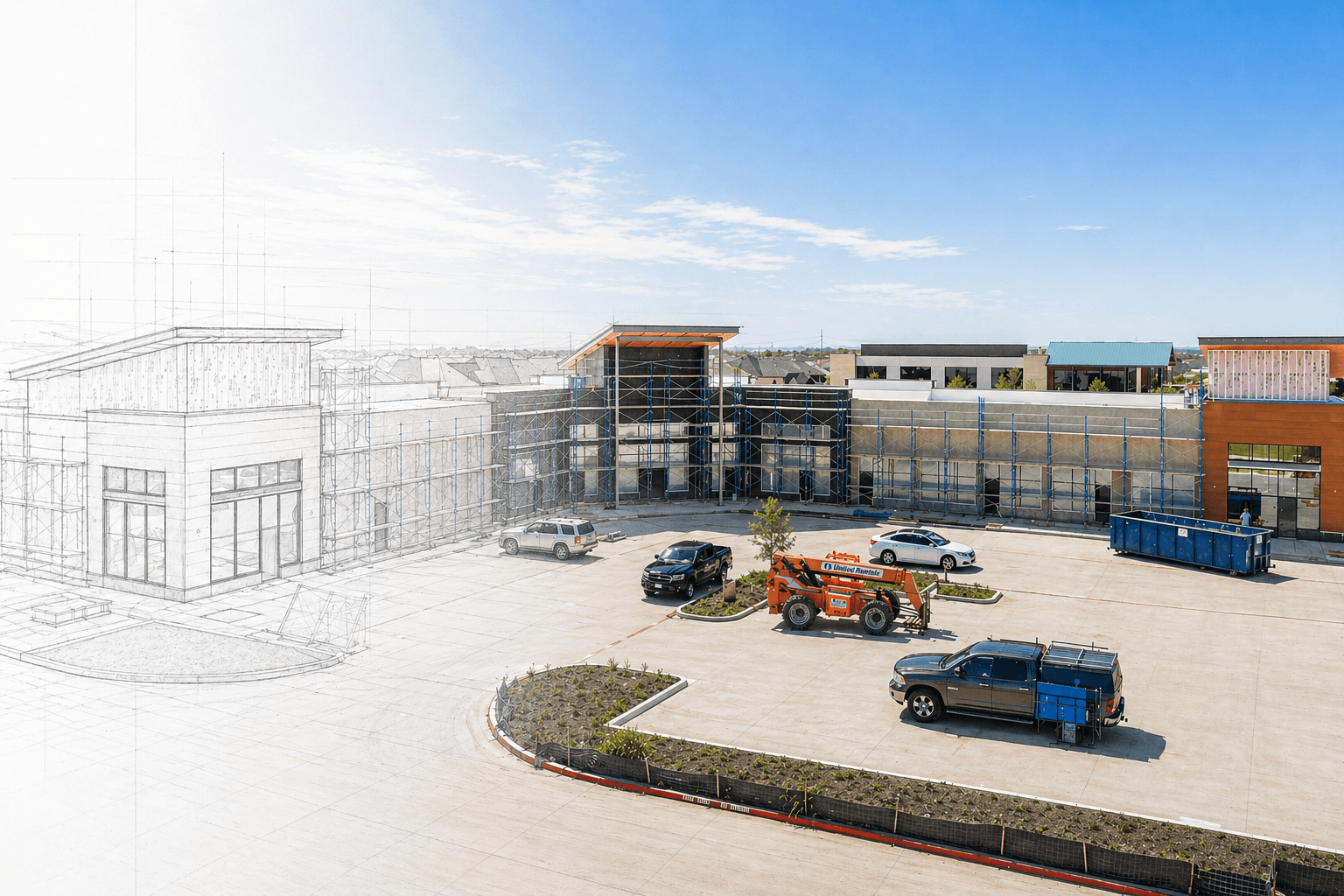

10 Questions to Ask a Commercial General Contractor in Texas Before Hiring
Hiring a commercial general contractor in Texas? Ask these questions about experience, costs, subcontractors, timelines, contracts, and project management.
Hiring a commercial general contractor in Texas is one of the biggest decisions you'll make for your business.
Whether you're building out a new retail space in Houston, renovating an office in Dallas, or breaking ground on a warehouse in Frisco, the contractor you choose will directly shape your budget, your timeline, and honestly, your stress levels for the next several months.
Here's the thing most business owners don't realize: Texas doesn't require a statewide license for general contractors.
There's no statewide exam, education requirement, or credential a general contractor in Texas has to hold, and the state doesn't participate in the National Association of State Contractors Licensing Agencies (NASCLA) reciprocity program.
That means literally anyone can call themselves a "general contractor" in Texas, regardless of experience or track record.
This isn't meant to scare you, but it should make you cautious. Without a state license acting as a built-in screening tool, the burden of vetting falls entirely on you. And the stakes are high.
Nationally, an estimated 98% of construction projects run over budget, behind schedule, or both, and industry research from McKinsey pegs the average cost overrun at roughly 28%.
Ask the right questions upfront, and you dramatically reduce your odds of becoming another statistic.
Below are the 10 questions every Texas business owner should ask before signing a contract, along with what a well-run firm, like TX Sparks Construction, would say in response.
1. Are You Registered With the City, and Are Your Subcontractors Properly Licensed?
Since Texas has no state license for general contracting, local registration and specialty licensing are your first real checkpoints.
Dallas, for example, requires an annual $120 contractor registration that covers commercial general contracting, roofing, fencing, foundation, demolition, and pool work, along with proof of liability insurance, a state sales tax permit, and a certificate of occupancy.
Moreover, Austin, Houston, and San Antonio each run their own registration systems too, so requirements shift depending on where your project sits.
Just as important: ask who's doing the electrical, plumbing, and HVAC work.
General contracting itself isn't licensed in Texas, but performing electrical or HVAC work without proper credentials can trigger administrative penalties of up to $5,000 per violation from the Texas Department of Licensing and Regulation.
As of January 2026, the Texas State Board of Plumbing Examiners also imposes a flat $4,000 penalty on any contractor who employs an unregistered plumbing worker.
If your contractor can't name their licensed trade partners on the spot, treat that as a red flag.
You can also read: Starting a Commercial Build in DFW: 8 Things You Should Know.
2. What's Your Experience With Projects Like Mine?
A contractor who's great at building strip malls may not be the right fit for a medical office build-out with strict compliance codes.
Ask for two or three completed projects that closely match your scope, size, and industry.
Then, go a step further and actually visit one if you can, or at least speak with the client who commissioned it. Photos on a website can be curated; a direct conversation with a past client usually can't.
This is also a good moment to ask how long the firm has been operating in Texas specifically, since local code knowledge, permitting relationships, and municipal familiarity tend to compound with time.
TX Sparks Construction, for instance, has been building across the Dallas-Fort Worth area since 2016, giving its team over a decade of hands-on experience navigating Texas permitting and inspection processes.
You can also read: 8 Ways to Deliver a Commercial Building with Zero Change Orders.
3. Can You Provide Proof of Insurance and Bonding?
This one isn't optional. Commercial general liability insurance in Texas typically runs between $1,000,000 and $2,000,000, with the property owner named as an additional insured, and most municipal registrations require at least $300,000 to $1,000,000 in coverage per occurrence.
Notably, Texas is unique in that workers' compensation is optional for private employers, and roughly 72% of employers reportedly opt out of it.
That means you need to specifically ask whether your contractor carries workers' comp, because if they don't and a worker is injured on your property, your business could end up absorbing the liability.
Always ask for a certificate of insurance directly from the carrier, not just a photocopy the contractor hands you.
You can also read: What is the Payment Bond in Construction?
4. What Does Your Detailed Bid Actually Include?
A vague, one-page estimate is a warning sign.
A trustworthy contractor should give you a line-item breakdown covering materials, labor, permits, equipment rental, and contingency costs.
Transparency here matters because change orders are where budgets quietly spiral.
In fact, research on large-scale construction projects found that design changes alone contribute to roughly 56.5% of cost overruns and 40% of project delays.
Ask upfront how the contractor documents and prices change orders, so there are no surprises mid-project.
5. What's Your Realistic Timeline, and What Could Delay It?
Every contractor will give you a timeline. The good ones will also tell you what might blow it up.
Given that recent industry data shows roughly 98% of construction projects face delays, with average project duration extending about 37% longer than originally projected, you want a contractor who's upfront about permitting backlogs, material lead times, and weather risk in your specific region, rather than one who promises an unrealistically tight schedule just to win your business.
Ask them to walk you through the project in phases, with milestones you can actually track, and ask for evidence of their on-time delivery record rather than just a verbal promise.
You can also read: 5 Steps to Reduce Construction Delays in North Texas Projects.
6. How Do You Handle Material Costs and Price Volatility?
Material pricing has been a moving target for the past several years, and it's still a live issue.
Steel, concrete, and electrical components in particular continue to see meaningful price swings, which makes accurate cost forecasting harder across the industry.
Ask your contractor whether they lock in material prices at contract signing, how they handle mid-project price increases, and whether that risk is baked into your fixed price or passed on to you.
This single conversation can save you thousands down the line.
7. Who Will Actually Be Managing My Project Day-to-Day?
The person who wins your bid isn't always the person running your job site.
Ask specifically who your project manager or superintendent will be, how often they're on-site, and how you'll communicate with them.
A dedicated point of contact who answers calls and gives you honest updates is worth more than the flashiest sales pitch.
If a contractor is vague about who's actually supervising the work, push for a name and a direct line before you sign anything.
You can also read: 7 Common Mistakes First-Time Commercial Developers Make.
8. Can You Share References and Reviews From Recent Texas Projects?
Ask for at least three references from projects completed in the last two years, ideally in your city, since municipal codes and inspection processes vary across Texas.
Call each one. Ask specifically about communication, whether the budget held, and whether the final product matched what was promised.
A contractor who hesitates to provide recent, local references likely has something to hide, while one that has a healthy, visible portfolio of past clients, such as TX Sparks Construction's work with brands like Paris Baguette, Cold Stone Creamery, and Arka Montessori Academy, makes it easy for you to verify their track record.
9. How Do You Address Labor Shortages and Subcontractor Reliability?
Labor availability is a real constraint right now.
The Associated Builders and Contractors reported roughly 349,000 unfilled construction positions at the start of 2026, and the Associated General Contractors of America found that 45% of firms cite project delays specifically due to labor shortages.
Ask your contractor how they staff jobs, whether they rely on a stable bench of trusted subcontractors, and what their backup plan is if a sub falls through mid-project.
A contractor with long-standing subcontractor relationships is far less likely to leave you stuck waiting on a crew that never shows up.
You can also read: 11 Things Developers Should Know Before Starting a Commercial Build in DFW.
10. What Happens If There's a Dispute or the Work Doesn't Meet Expectations?
Nobody wants to think about conflict before a project even starts, but it's smart to know the process before you need it.
Ask how the contractor handles disagreements over workmanship, what their warranty covers, and for how long.
Get this in writing as part of your contract, not as a verbal promise.
Since Texas has no state licensing board to file a complaint against, your written contract terms, along with the contractor's bonding and reputation, become your strongest form of protection if something goes wrong.
Why TX Sparks Construction Checks Every Box on This List
If you're using this list as a benchmark, it helps to see what it looks like when a contractor genuinely meets it.
TX Sparks Construction is a Frisco-based general contractor serving commercial and residential clients across the Dallas-Fort Worth area, and here's how the firm stacks up against the questions above:
Founded in 2016 by Ravi Polishetty, who started the company after experiencing firsthand how delays, hidden costs, and poor communication can derail a construction project. That origin story shapes how the firm operates today.
Licensed, insured, and bonded, with bondability evaluated per project based on financial qualifications and project-specific terms.
A 100% on-time completion record across its portfolio, directly addressing the timeline and delay concerns raised in Question 5.
55+ successful projects completed, spanning ground-up construction, interior build-outs, land development, and construction management.
BBB accreditation, an independent, third-party marker of business trustworthiness.
An in-house engineering team with end-to-end capability, which reduces the handoff friction and miscommunication that often drives change orders.
Centralized communication and documentation, plus proprietary construction project management technology, giving clients real-time visibility instead of having to chase updates.
A full range of services covering land feasibility, land entitlement, MUD & PID services, design and permitting, land development, ground-up construction, interior build-out, and construction management, so you're not stitching together multiple vendors for a single project.
In short, TX Sparks Construction was built specifically to solve the problems this article warns you about.
You can also read: 10 Top General Contractors in Dallas, Texas (2026 Guide).
Conclusion
Choosing a commercial general contractor in Texas comes down to doing your homework before you sign anything.
Because the state leaves licensing largely in the hands of cities and specialty trade boards, you can't rely on a credential to do the vetting for you.
Instead, your questions, your due diligence, and your willingness to check references, insurance documents, and past project performance become your real safety net.
Take these 10 questions into your next contractor meeting, and pay close attention not just to the answers, but to how confidently and transparently they're given.
A contractor who welcomes tough questions is usually one who has nothing to hide, and that's exactly the kind of partner you want overseeing your next commercial build.
Ready to put these questions to the test?
TX Sparks Construction is happy to walk you through its licensing, insurance, bonding, and project history in detail, no pressure, just straight answers.
Get a free budget estimate or contact TX Sparks Construction today at +1 (469) 598-2558 to talk through your next commercial project in Texas.
Frequently Asked Questions
1. Does Texas require a license for general contractors?
No. Texas does not issue a statewide general contractor license, and there is no state exam or education requirement for general contracting. However, specialty trades like electrical, plumbing, and HVAC are licensed at the state level through the Texas Department of Licensing and Regulation (TDLR) and the Texas State Board of Plumbing Examiners (TSBPE), and many cities require their own contractor registration.
2. How do I verify a commercial contractor is legitimate in Texas?
Ask for proof of city registration (where applicable), a certificate of insurance sent directly from their carrier, evidence of bonding, and references from at least two or three recent, local projects. Since there's no state license to check, this documentation is your primary way to confirm legitimacy.
3. What insurance should a Texas commercial general contractor carry?
Most commercial owners and lenders require $1,000,000 to $2,000,000 in general liability coverage with the owner named as additional insured. Because workers' compensation is optional for private employers in Texas, it's worth confirming separately whether your contractor carries it.
4. Why do so many construction projects go over budget or run late?
Nationally, close to 98% of construction projects experience some degree of delay or cost overrun, often driven by design changes, labor shortages, material price volatility, and poor upfront planning. Asking detailed questions about bidding, change orders, and staffing before you sign is the most effective way to reduce that risk.
5. What should I look for in a general contractor's bid?
A trustworthy bid should be itemized, showing separate costs for materials, labor, permits, equipment, and contingency, rather than a single lump-sum number. It should also spell out how change orders will be priced and approved.
Disclaimer: This article is provided for general educational and informational purposes only and does not constitute professional, legal, financial, or engineering advice. While TX Sparks Construction makes every effort to keep this content accurate and current, we make no warranties as to its completeness, accuracy, or reliability. Construction codes, regulations, and requirements vary by location and project and are subject to change. Any action you take based on this information is strictly at your own risk. For guidance specific to your project, please consult a qualified professional or contact our team directly.