
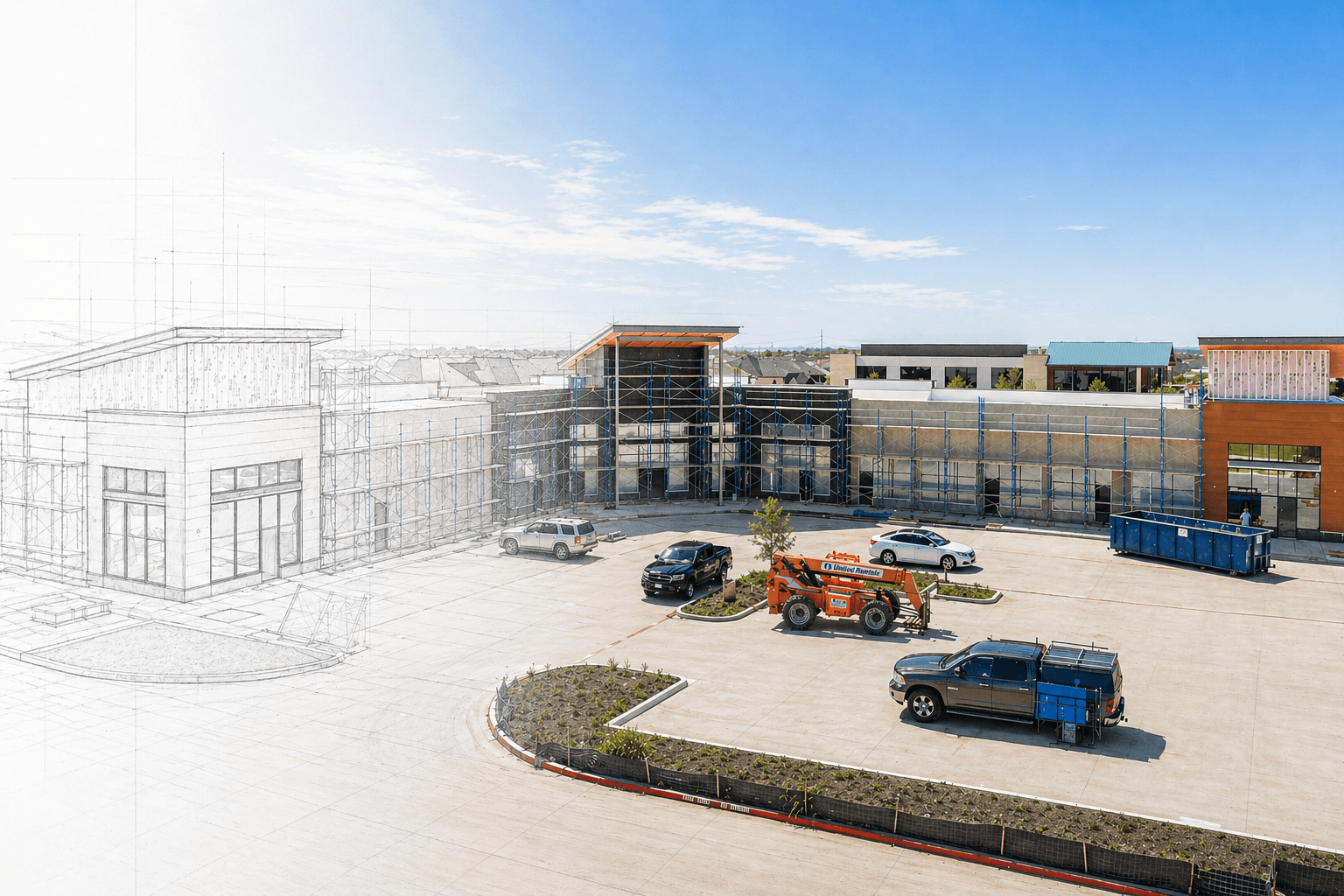

MUD, TIRZ & Incentives: 5 Things Developers Should Know in Texas
Learn the important things developers should know about MUD, TIRZ, and development incentives in Texas, including funding, infrastructure, and more.
Texas is booming. If you are a real estate developer, that statement represents an incredible opportunity, but it also highlights a massive logistical challenge.
The state's population growth continues to outpace almost every other region in the country, creating an insatiable demand for residential master-planned communities, mixed-use commercial hubs, and industrial spaces.
However, this rapid expansion exposes a fundamental hurdle: raw land does not come with roads, water lines, or sewage treatment plants.
If you attempt to fund 100% of that public infrastructure upfront out of your own pocket or through high-interest private financing, your project's internal rate of return (IRR) will plummet before you even pour the first foundation.
This is where Texas gets creative. Unlike states that saddle developers with astronomical impact fees and rigid bureaucratic red tape, Texas offers a robust toolkit of public-private financing mechanisms.
The heavy hitters in this toolkit are Municipal Utility Districts (MUDs) and Tax Increment Reinvestment Zones (TIRZs), frequently paired with Chapter 380/381 Economic Development Agreements.
Understanding how to leverage these incentives is no longer just a strategy for maximizing profit; it is a requirement for making large-scale projects financially viable.
To successfully navigate these complex structures, partnering with an experienced general contractor in Texas, like TX Sparks Construction, makes all the difference in aligning your civil engineering with state compliance.
Let's dive deep into what Texas developers must know to navigate these structures successfully.
1. Municipal Utility Districts (MUDs): Offloading the Burden of Water and Waste
When you are looking at hundreds of acres of raw Texas land outside city limits, your first question is always: How do I get water here?
A Municipal Utility District (MUD) is a specialized political subdivision of the State of Texas.
It is created with a singular primary purpose: to finance, construct, and operate public water, sewer, drainage, and other infrastructure within its defined boundaries.
How a MUD Works for Developers
Instead of paying for all water plants, lift stations, storm sewers, and major thoroughfares out of your equity or construction loans, a MUD allows you to advance the money for construction and eventually get repaid.
Here is the step-by-step lifecycle:
The Advance: The developer funds and builds the eligible public infrastructure upfront. (This is where having a vetted, highly capable contractor ensures the infrastructure is built strictly to municipal standards from day one).
The Tax Base: As homes are built and sold, residents move in. The property value of the district rises significantly.
The Bond Issuance: Once the district has sufficient taxable value, the MUD board issues tax-exempt municipal bonds to the public market.
The Reimbursement: The proceeds from these bond sales are used to reimburse you, the developer, for your qualified upfront infrastructure costs.
The Payback: The MUD levies a property tax on the homeowners within its boundaries to service that bond debt over a 20-to-30-year period.
Why This Matters for Your Bottom Line
Think about the financial math. If a master-planned community requires $30 million in off-site and on-site water and drainage infrastructure, that is $30 million of developer capital locked up.
By utilizing a MUD, you can recoup up to 100% of those eligible infrastructure costs plus interest. This dramatically reduces your cash-in-deal metric and skyrockets your project's ultimate IRR.
Furthermore, because the MUD levies its own property tax to pay off the bonds, the local municipality or county does not have to take on debt to support your project. It is a true win-win.
Developer Insight: MUD bonds cannot be issued on hope. Texas regulatory bodies, specifically the Texas Commission on Environmental Quality (TCEQ), enforce strict "no-speculation" rules. You typically must hit specific debt-service coverage ratios, meaning a certain number of homes must be built and on the tax rolls, before the MUD can issue bonds to pay you back.
2. Tax Increment Reinvestment Zones (TIRZ): Capturing Future Tax Dollars
While MUDs are the kings of residential utility infrastructure in unincorporated areas, Tax Increment Reinvestment Zones (TIRZs), governed by Chapter 311 of the Texas Tax Code, are the ultimate tool for urban infill, commercial, and mixed-use redevelopments.
The Mechanics of "Captured" Value
A TIRZ does not create a new tax or raise existing tax rates. Instead, it alters where future tax revenue goes.
When a city or county designates a geographic boundary as a TIRZ, they establish a base year property valuation.
As you develop the land, property values climb. The difference between the new, higher appraised value and the base value is called the captured appraised value.
Current Appraised Value - Base Value = Captured Appraised Value
The local taxing entities (the city or county) agree to redirect all or a portion of the property taxes collected on that captured value into a dedicated Tax Increment Fund (TIF).
What Can TIRZ Funds Pay For?
Unlike MUDs, which are strictly focused on utility and basic roadway infrastructure, TIRZ funds feature a much broader scope of eligibility. You can use TIRZ revenues to fund:
Public parks, greenways, and streetscapes
Sidewalks, street lighting, and pedestrian plazas
Public parking garages
Environmental remediation and demolition of blighted structures
Affordable housing initiatives within the zone
The Real-World Application
Imagine purchasing an abandoned, blighted industrial site in a major Texas metro area with a base valuation of $5 million. You plan to build a $150 million mixed-use retail and residential destination.
The city establishes a TIRZ, agreeing to contribute 70% of the city's portion of the property tax increment to the TIF for 20 years.
As your project fills up and values rise to $150 million, millions of dollars flow into the TIF annually.
Those funds are used to directly reimburse you for the massive parking garage and public plaza you constructed, costs that otherwise would have made the project economically unfeasible.
Managing these multifaceted public-facing builds requires deep commercial expertise, which is exactly where the specialized teams at TX Sparks Construction excel.
You can also read: Understanding Preconstruction Services: Why Early Planning Saves Millions.
3. Comparing MUDs vs. TIRZs
Choosing between a MUD and a TIRZ depends heavily on your project's location, product type, and target market.
Feature | Municipal Utility District (MUD) | Tax Increment Reinvestment Zone (TIRZ) |
Primary Location | Unincorporated county areas, ETJs (Extraterritorial Jurisdictions) | Infill urban areas, blighted commercial zones, and cities |
Tax Impact | Levies a new, additional property tax on residents | Uses existing tax rates; redirects the incremental growth |
Primary Use Cases | Large-scale residential master-planned communities | Mixed-use, commercial, retail, and urban residential |
Eligible Expenses | Water, sewer, drainage, some roads, and fire/park facilities | Roads, utilities, parking garages, streetscapes, parks, demo |
Governing Body | An elected Board of Directors (initially developer-controlled) | A Board appointed by the participating city/county |
4. Chapters 380 & 381: The Ultimate Deal Closers
Even with MUDs and TIRZs in place, complex projects often need an extra push to achieve financial viability.
This is where Chapter 380 (for cities) and Chapter 381 (for counties) of the Texas Local Government Code come into play.
These statutes grant local governments immense flexibility to offer loans and grants of public money to stimulate commercial, retail, or industrial activity.
How Developers Leverage 380/381 Agreements
Cities and counties regularly use Chapter 380/381 agreements to craft custom incentive packages. For developers, these typically manifest in a few distinct formats:
Sales Tax Rebates: If you are developing a regional retail center or a major auto dealership, the city may agree to rebate a percentage of the municipal sales tax generated by the businesses on your property for a set number of years.
Direct Economic Development Grants: The city may provide a direct cash grant to offset specific project costs, such as upgrading an off-site traffic signal or expanding a nearby electrical substation.
Property Tax Abatements: Local jurisdictions can agree to forgive or rebate a portion of your real property taxes for a specified timeframe while your project stabilizes.
Transparency Requirements
Because these agreements deal with direct public funds, Texas maintains strict transparency laws.
According to the Texas Comptroller's Office, local governments must report all active Chapter 380 and 381 agreements to a centralized, public online database within 14 days of execution. Failure to do so can result in hefty financial penalties for the municipality.
As a developer, this database is a goldmine. It allows you to audit what types of incentives neighboring cities are offering, providing you with invaluable benchmarks when entering your own negotiations.
You can also read: 5 Steps to Reduce Construction Delays in North Texas Projects.
5. Strategic Steps for Developers: How to Navigate the Incentive Landscape
Securing public financing in Texas requires a deliberate, proactive strategy.
You cannot simply show up to a city council meeting with a cocktail-napkin sketch and ask for millions in incentives. To successfully navigate this landscape, follow this strategic roadmap:
Step 1: Engage Early and Align with Local Priorities
Long before you submit official plats or engineering designs, schedule introductory meetings with city managers, county judges, and economic development corporations (EDCs). Understand their master plans.
If a city is desperate for high-density retail or corporate relocation sites, tailoring your project to fit that need gives you immense leverage when asking for a TIRZ or Chapter 380 agreement.
Step 2: Conduct a Precise "But For" Analysis
To legally and politically justify granting incentives, public officials must believe that your project would not have happened "but for" the financial assistance provided.
You must be prepared to present rigorous underwriting, showing that without a MUD or TIRZ reimbursement, your project's returns fall below the threshold required by institutional lenders and equity partners.
Step 3: Model Your Reimbursement Timelines Conservatively
A common trap for novice developers is assuming that infrastructure money will flow back into their pockets immediately.
Remember, MUD bonds require home construction milestones, and TIRZ funds require actual property appreciation to hit the tax rolls. Always underwrite with a conservative buffer.
Step 4: Assemble an Expert Advisory Team
Public finance in Texas is highly specialized.
To execute these strategies successfully, your team should include specialized land-use attorneys, public finance advisors, civil engineers, and an experienced civil general contractor in Texas who knows how to document and track reimbursable construction costs accurately for state audits.
You can also read: What Is Land Entitlement and Why It Matters for Your Construction Project.
Why Texas Developers Rely on TX Sparks Construction
Navigating MUD, TIRZ, and Chapter 380/381 incentives requires more than just financial modeling; it demands flawless field execution.
Public infrastructure must be built to exacting municipal, county, and TCEQ standards, or your hard-earned reimbursements could be delayed or denied entirely.
At TX Sparks Construction, we bridge the gap between complex municipal finance and real-world construction. With over a decade of deep Texas roots, we specialize in:
Compliant Public Infrastructure: From major master-planned utility installations to urban streetscapes and public parking garages, we build strictly to city, county, and state codes.
MUD & TIRZ Cost Tracking Audit Readiness: We understand the stringent auditing procedures required by public boards. Our transparent reporting ensures every dollar spent on reimbursable public works is cleanly documented, accelerating your pathway to bond reimbursement.
Value Engineering for Maximum IRR: We work hand-in-hand with your engineering and advisory teams to optimize infrastructure layouts, lowering upfront development costs and keeping your project on track.
When you partner with TX Sparks Construction, you aren't just hiring a builder; you are securing an asset to your development team that protects your margins from groundbreaking to final bond payout.
You can also read: 6 Steps to Select the Right General Contractor for Your Commercial Project.
Conclusion
In Texas, infrastructure does not have to be a financial dead weight that breaks your project's budget.
By masterfully combining Municipal Utility Districts, Tax Increment Reinvestment Zones, and Chapter 380/381 agreements, you can effectively shift the burden of public infrastructure from your balance sheet to the future tax base your development creates.
The Texas market remains incredibly lucrative, but the margins belong to the developers who know how to play the public financing game strategically and build defensively.
Treat cities and counties as your equity partners, align your goals with their growth, and build with the right partner to unlock the true value of your next Texas development.
Ready to Maximize the Returns on Your Next Texas Project?
Don't leave money on the table or risk your future reimbursements with sub-par execution. Before you break ground, ensure your infrastructure meets the gold standard required for MUD and TIRZ bond approval.
Contact the team at TX Sparks Construction today for a comprehensive construction consultation. Let's build Texas together, strategically.
Disclaimer: This article is provided for general educational and informational purposes only and does not constitute professional, legal, financial, or engineering advice. While TX Sparks Construction makes every effort to keep this content accurate and current, we make no warranties as to its completeness, accuracy, or reliability. Construction codes, regulations, and requirements vary by location and project and are subject to change. Any action you take based on this information is strictly at your own risk. For guidance specific to your project, please consult a qualified professional or contact our team directly.