
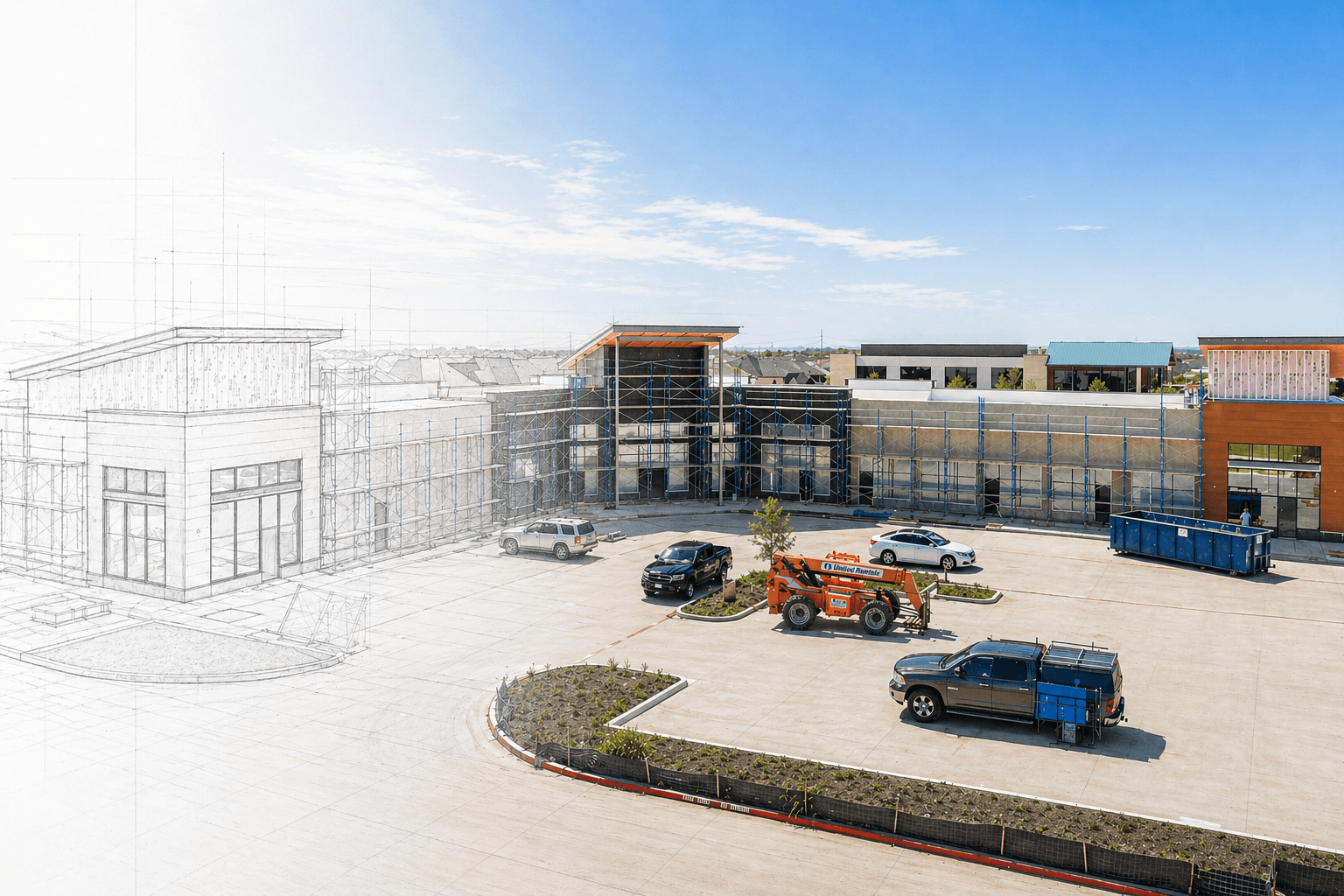

11 Things Developers Should Know Before Starting a Commercial Build in DFW
Before starting a commercial construction project in DFW, understand the key factors, including site conditions, utilities, financing, and more.
Dallas–Fort Worth continues to be one of the strongest real estate markets in the country.
Every week, developers and investors evaluate land for retail centers, medical offices, daycares, restaurants, warehouses, office buildings, multifamily projects, mixed-use developments, and residential communities.
Most conversations start with two questions:
How much will it cost to build?
How quickly can we start construction?
Those are important questions. But they shouldn't be the first questions.
Before buying the land, hiring an architect, or discussing construction costs, a developer needs to determine whether the project actually makes financial sense.
From our experience working with developers across DFW, here are 11 of the most important things to understand before moving forward with a commercial development project.
1. Start With a Market Study, Not the Land Price
Before buying land, hire an experienced market study analyst who understands the specific market and the proposed future use of the property.
The question isn't simply: "What is this land worth today?"
The better question is: "What can realistically be developed here, and what will that development be worth?"
A good market study should evaluate factors such as:
Future land use
Current and projected demand
Existing and upcoming supply
Absorption rates
Recent land sale comparables
Residential sale comparables
Commercial lease comparables
Industrial lease and sale comparables
Rental rates
Vacancy and occupancy
Competing developments
Demographics and population growth
Traffic and surrounding development
Expected future inventory
The analysis will vary depending on whether you're considering residential, retail, office, multifamily, industrial, hospitality, or mixed-use development.
For example, knowing that industrial rents are strong doesn't mean another industrial project will automatically work.
Also, you need to understand how much competing space is under construction, how quickly existing inventory is being absorbed, and what tenants are actually willing to pay.
The same applies to residential development. Strong home prices don't necessarily mean a subdivision will work if there is already significant lot and home inventory in the surrounding market.
Don't fall in love with the land first and then try to make the numbers work. Let the market tell you what the land can support.
The market study becomes one of the foundations of the project's financial pro forma.
You can also read: 10 Steps to Evaluate a Raw Land Deal Before You Close in Texas.
2. Build the Financial Pro Forma Before You Buy the Land
Once the market study provides realistic assumptions for sales prices, rents, absorption, and demand, the next step is to hire an experienced financial analyst to prepare a detailed development pro forma.
This is one of the most important steps in the entire decision-making process.
The pro forma should evaluate the complete development, not simply the land purchase price and construction cost.
Depending on the project, the analysis should include:
Land acquisition price
Closing and due diligence costs
Entitlement costs
Zoning or rezoning costs
Architecture and engineering
Permitting and municipal fees
Utility infrastructure
Off-site improvements
Vertical construction
Financing and interest carry
Property taxes
Insurance
Leasing commissions
Marketing expenses
Developer and professional fees
Contingencies
Expected lease rates or sales prices
Absorption assumptions
Stabilization period
Exit value
The model should answer one critical question:
What can I afford to pay for this land and still achieve the return I'm looking for?
That's very different from asking what the seller wants for the property.
If the seller wants $5 million but your financial model says the project only supports a $3.8 million land basis, you've learned something extremely valuable before putting millions of dollars at risk.
A proper financial analysis should also include multiple scenarios:
What happens if construction costs increase by 10%?
What happens if rents are 5% lower?
What happens if entitlement takes six months longer?
What happens if absorption is slower than projected?
A development shouldn't work only under the perfect scenario.
The market study tells you what may be possible. The financial pro forma tells you whether it is worth doing.
You can also read: Starting a Commercial Build in DFW: 8 Things You Should Know.
3. Don't Buy the Land Based on the Purchase Price Alone
Once the market and financial feasibility make sense, the next step is understanding the property itself.
A piece of land may look like a great deal until you understand what it will actually take to develop it.
Before closing, developers should have a clear picture of:
Current zoning
Future land use designation
Permitted use
Utility availability and capacity
Water and sewer locations
Drainage requirements
Detention requirements
Fire access
TxDOT or city access requirements
Easements
Floodplain
Topography
Off-site improvements
Impact and development fees
We've seen projects where the building itself made financial sense, but unexpected site-development costs completely changed the economics of the deal.
Saving $300,000 on the land doesn't mean much if the site requires another $800,000 of infrastructure that wasn't included in the original underwriting.
The cheapest land is not always the cheapest project.
4. Understand the City Before You Finalize Your Schedule
DFW may be one market, but it consists of dozens of cities, and every municipality operates differently.
Frisco is different from Plano. McKinney is different from Prosper. Melissa is different from Dallas.
The entitlement, zoning, engineering, fire review, platting, permitting, and inspection processes can vary significantly from one jurisdiction to another.
Before acquiring land, understand what approvals are required and, more importantly, how long they are realistically going to take.
If your financial model assumes construction starts in six months but approvals actually take twelve months, those additional six months have a real cost.
During that period, you may still be carrying:
Land interest
Loan fees
Property taxes
Insurance
Investor capital
Engineering expenses
Professional fees
Predevelopment overhead
Time is a real development cost.
It needs to be underwritten just like concrete, steel, or HVAC.
5. Utility Availability Does Not Mean Utility Capacity
This is one of the areas developers should pay close attention to during due diligence.
Seeing a water line, sewer line, or electrical service next to a property doesn't automatically mean the infrastructure can support your development.
There is a major difference between availability and capacity.
Depending on the development, additional work could include:
Water or sewer line extensions
Line upsizing
Lift stations
Electrical transformers
Electrical service upgrades
Fire-flow improvements
Gas extensions
Road improvements
Off-site infrastructure
These improvements can significantly affect both the budget and the schedule.
Verify them before buying the land, not after closing.
6. Your Civil Plan Can Make or Break the Budget
Developers naturally spend a lot of time thinking about the building.
But some of the biggest development costs may actually be outside the building:
Parking
Paving
Storm drainage
Detention
Retaining walls
Utilities
Fire lanes
Site grading
Landscaping
Road improvements
A difficult site can easily add hundreds of thousands—or even millions—of dollars to a development.
This is why early civil engineering and site-development budgeting are so important.
A beautiful architectural rendering doesn't tell you what it costs to make the land ready for that building.
You can also read: How Civil Engineering & Site Planning Impact Project ROI in Texas.
7. Get the Builder Involved Before the Drawings Are Finished
Another common mistake is completing architecture and engineering first and then sending the drawings to contractors for pricing.
By that point, many important cost decisions have already been made.
A commercial general contractor in DFW should ideally be involved during design and preconstruction.
The builder can work with the architect, civil engineer, structural engineer, and MEP consultants to evaluate:
Constructability
Structural systems
MEP selections
Site conditions
Material selections
Procurement timelines
Current subcontractor pricing
Value-engineering opportunities
Changing something while it is still on paper is relatively inexpensive.
Changing the entire design because the project came in $2 million over budget is a very different conversation.
Design and budget should develop together.
You can also read: Understanding Preconstruction Services: Why Early Planning Saves Millions.
8. Don't Underwrite a Project Using Only a Cost-Per-Square-Foot Number
We hear this question all the time: "What's your price per square foot?"
It's a reasonable question for preliminary discussions, but it can become dangerous when used to make an investment decision.
Two 20,000-square-foot commercial buildings can have completely different costs.
One may have flat land, utilities at the property, straightforward drainage, surface parking, and simple construction.
The other may require extensive grading, detention, retaining walls, utility extensions, electrical upgrades, and major off-site improvements.
Same building size. Completely different development cost.
Cost per square foot can be useful as an early benchmark.
It should never replace a complete project budget.
You can also read: Infrastructure Costs in Texas Developments: What Investors Ignore.
9. Know What Is Included in the Construction Number
When comparing contractor pricing, don't compare only the number at the bottom of the proposal.
Compare the scope behind the number.
Does the pricing include:
Site work?
Utilities?
Landscaping?
Fire alarm and sprinkler?
Permit fees?
Testing?
Temporary utilities?
General conditions?
Builder's risk?
Allowances?
Escalation?
Off-site improvements?
A lower bid isn't necessarily a lower project cost.
Sometimes it is simply a smaller scope.
Developers should understand exactly what is included, excluded, and carried as an allowance before selecting a contractor.
10. Financing and Construction Need to Speak the Same Language
Commercial construction financing creates another layer of complexity.
Draw schedules, inspections, lien waivers, retainage, stored materials, lender approvals, and pay applications all affect cash flow.
If these processes aren't organized from day one, construction can move faster than the paperwork required to fund it.
The developer, GC, lender, architect, and accounting team should understand the draw process before construction begins.
The financing structure should also be incorporated into the original financial pro forma so the true cost of capital is understood from the beginning.
You can also read: 7 Ways to Make a Commercial Construction Project Bankable in Texas.
11. Think Like a Developer Before You Think Like a Builder
Commercial development doesn't begin when concrete is poured.
The real process looks more like this:
Market Study → Financial Feasibility → Land Due Diligence → Acquisition → Entitlements → Zoning → Design → Engineering → Permitting → Land Development → Construction → Inspections → Leasing/Sales → Stabilization
Each step affects the next one.
At TX Sparks Construction, we believe a GC can add significantly more value when brought into the project early.
Before talking about construction, we want developers to understand:
Does the market support the project?
Does the financial pro forma work?
Is the land worth the asking price based on the proposed development?
What infrastructure could affect the budget?
What could delay entitlements or permits?
What decisions can we make today that could save money six or twelve months from now?
Because by the time construction starts, many of the decisions that determine whether a development succeeds or struggles have already been made.
You can also read: 7 Common Mistakes First-Time Commercial Developers Make.
Before You Buy. Before You Design. Before You Build.
If you're considering a commercial development in DFW, don't begin with:
"How much will it cost to build?"
Start with:
"Does this deal make sense?"
First, understand the market.
Then build the financial model.
Then understand the land.
Then determine what it will take to develop and build it.
At TX Sparks Construction, we work with developers from early feasibility and preconstruction through entitlements, permitting, land development, and ground-up construction across DFW.
Our objective isn't simply to build the building.
It's to help developers understand the project before they commit millions of dollars to building it.
TX Sparks Construction
Feasibility. Preconstruction. Land Development. Ground-Up Construction.
Know the deal. Know the risk. Then build.
Disclaimer: This article is provided for general educational and informational purposes only and does not constitute professional, legal, financial, or engineering advice. While TX Sparks Construction makes every effort to keep this content accurate and current, we make no warranties as to its completeness, accuracy, or reliability. Construction codes, regulations, and requirements vary by location and project and are subject to change. Any action you take based on this information is strictly at your own risk. For guidance specific to your project, please consult a qualified professional or contact our team directly.