
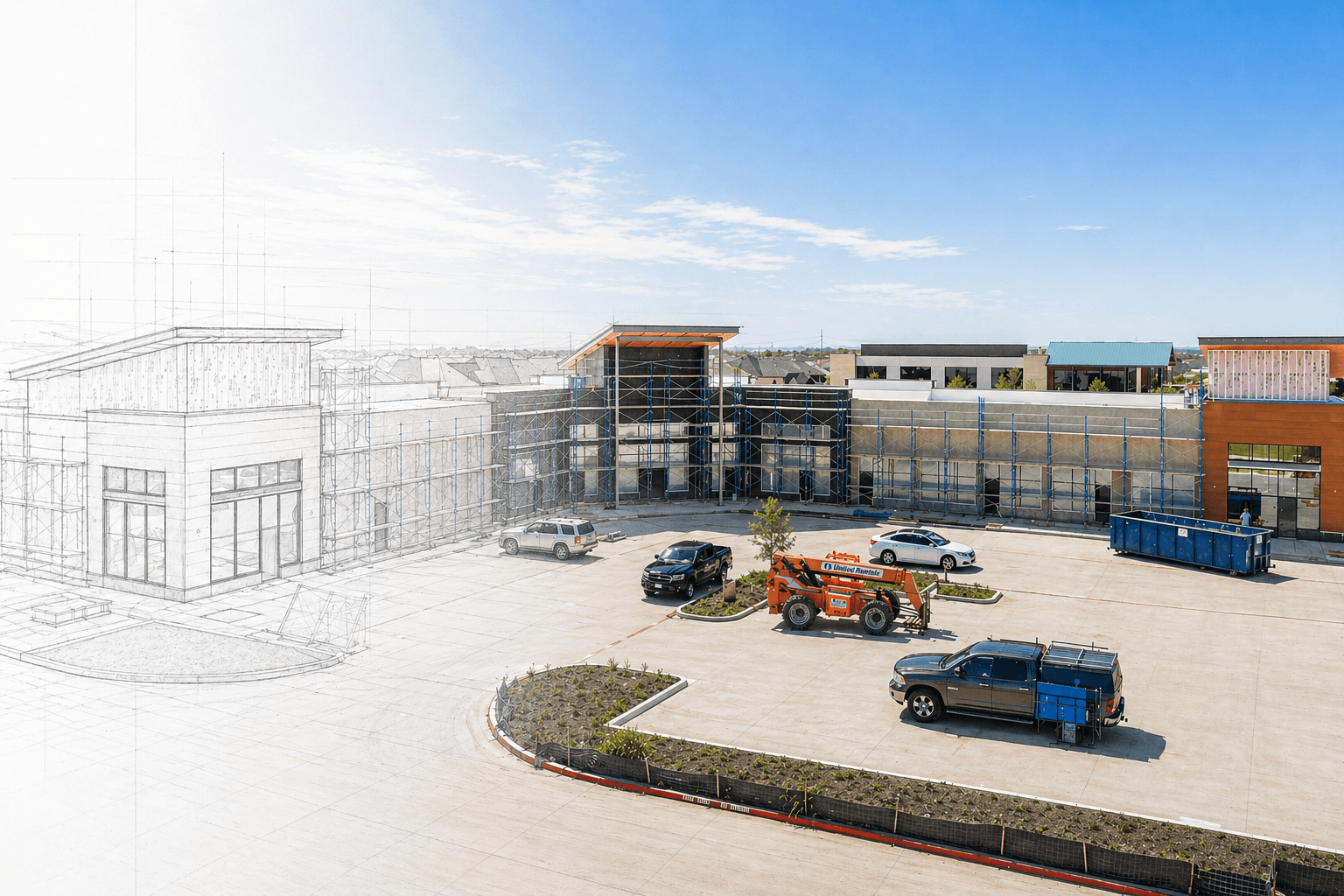

Retail Store Build-Out in Texas: A Complete Guide
Learn everything about retail store build-outs in Texas, including planning, permitting, design, timelines, budgeting, and tips for a successful project.
Opening a retail store in Texas is an exciting milestone, but the space between signing a lease and cutting the ribbon is where most owners feel the pressure.
Between permits, contractors, budgets, and inspections, a build-out can quickly turn from a simple renovation into a project that tests your patience and your bank account.
The good news? Texas is one of the most active and business-friendly retail construction markets in the country, and most of the confusion around build-outs comes down to a lack of clear information.
This guide walks you through exactly what a retail build-out involves, what it costs, how long it takes, and how to avoid the mistakes that derail timelines and budgets across the state.
Along the way, we'll also show you where an experienced general contractor in Texas, like TX Sparks Construction, can take the guesswork off your plate entirely.
What Exactly Is a Retail Build-Out?
A retail build-out is the process of converting an empty or unfinished commercial space into a fully functional, customer-ready store.
Depending on the condition of the space you lease, this can mean starting from a bare "cold dark shell" with no walls, flooring, or utilities, or working with a "vanilla shell" that already has basic HVAC, lighting, and restrooms in place.
Either way, the build-out typically covers:
Interior framing, drywall, and finishes
Flooring, ceilings, and paint
HVAC, electrical, and plumbing systems
Lighting design and fixtures
Storefront elements, signage prep, and millwork
Permitting, inspections, and project management
The starting condition of your space is the single biggest factor in your final cost, so it's worth confirming this with your landlord before you budget anything else.
This is exactly where a full-service general contractor earns its keep.
TX Sparks Construction handles retail interior build-outs across Texas, from pre-construction planning and design integration to construction execution and final close-out, so retailers aren't left coordinating trades, designers, and inspectors on their own.
You can also read: What Is Land Entitlement and Why It Matters for Projects.
How Much Does a Retail Build-Out Cost in Texas?
Cost is naturally the first question on every retailer's mind, and Texas has a genuine advantage here.
Retail build-out costs across the state generally fall between $140 and $190 per square foot, with most projects landing around $160 per square foot.
That's a meaningful discount compared to markets like Northern California, where in-line store fit-outs average closer to $211 per square foot.
To put that in perspective, national in-line retail fit-out costs average around $155 per square foot, while the most affordable U.S. region, the Southeast, averages roughly $117 per square foot.
Texas sits competitively within this range, offering big-city infrastructure without the premium pricing of coastal markets.
Your final number will still shift based on store type:
Basic or discount retail: roughly $40-$90 per square foot
Mid-tier retail and apparel: roughly $90-$180 per square foot
Premium or specialty retail (electronics, wellness, high-end boutiques): roughly $150-$300 per square foot
Flagship or luxury concepts: can exceed $300-$500 per square foot once bespoke fixtures, statement storefronts, and premium materials come into play
Within these ranges, a few line items consistently eat up the biggest share of the budget.
Flooring alone tends to average around $2.76 per square foot, while HVAC installation or replacement runs about $2.61 per square foot, or roughly $13,000 for a 5,000-square-foot space.
If your lease requires a full HVAC replacement, that's a cost worth negotiating into your landlord's contribution before you sign anything.
A practical tip: always request at least three detailed bids with identical scope specifications from contractors.
This is the single best way to validate whether your per-square-foot estimate is realistic and to identify a construction partner who understands Texas retail work specifically.
If you'd rather skip the guessing entirely, TX Sparks Construction offers a free budget estimate tool on its website, giving retailers a realistic starting number before they ever sit down with a contractor.
You can also read: How Civil Engineering & Site Planning Impact Project ROI in Texas.
Understanding Tenant Improvement (TI) Allowances
Most Texas retail leases include a tenant improvement allowance, a per-square-foot credit your landlord contributes toward construction costs, often in the $25-per-square-foot range, though this is negotiable.
It's easy to treat this allowance as "free money," but that's rarely the full picture.
The real cost of your build-out is what remains after the TI allowance is applied, not the sticker price on your contractor's estimate.
Before signing your lease, run the math on total occupancy cost, meaning your rent, common area maintenance charges, and amortized TI costs net of the landlord's allowance.
For retail specifically, that combined figure should ideally stay within 8 to 12 percent of your projected sales.
If your build-out costs push you above that range, it's worth negotiating a higher allowance, a longer lease term to spread out the cost, or reconsidering the space altogether.
You can also read: Starting a Commercial Build in DFW: 8 Things You Should Know.
Permitting in Texas: What Makes It Different
Texas permitting has its own rhythm, and it catches a lot of out-of-state retailers off guard.
Beyond your standard city building permit, which reviews plans against the International Building Code, Texas layers on a state-level requirement that doesn't exist in most other states.
Any commercial project valued at $50,000 or more must be registered with the Texas Department of Licensing and Regulation (TDLR) for a Texas Accessibility Standards (TAS) review, conducted by a Registered Accessibility Specialist (RAS).
This process runs parallel to, not instead of, your city permit review, and it's one of the most common sources of delay for retailers building out space in Texas.
Here's how the TDLR process generally works:
Project registration through the Texas Architectural Barriers System (TABS) portal
Plan submission to a RAS within 20 days of your plans being issued for construction
Plan review, which typically takes four to six weeks
Post-construction inspection once the build-out is complete
Missing or delaying this registration is consistently flagged as one of the top reasons commercial permits stall in Texas cities.
In fact, incomplete plan sets or missed TDLR requirements can add another 10 to 15 business days to your review timeline on top of the standard process.
A few other state-level requirements worth knowing:
All plans must be prepared and sealed by a Texas-licensed architect or engineer.
Projects must comply with the state energy code, currently based on the International Energy Conservation Code.
If you're renovating a building constructed before 1980, an asbestos survey certification is required before permits are issued.
Given how much local review times vary, it's worth checking your specific city's median permit timeline.
In Dallas, for example, the overall median review time for all commercial and residential permits was 189 days in 2024, though the city has made steady year-over-year improvements.
Building this kind of buffer into your project timeline from day one will save you from unrealistic opening-date promises to stakeholders or franchise partners.
A Realistic Build-Out Timeline
While every project varies by scope and location, most Texas retail build-outs, from lease signing to opening day, fall somewhere between four and nine months.
That includes:
Design and space planning
Landlord design review (especially in malls and lifestyle centers, which often runs alongside city permitting)
City permitting and TDLR/TAS review
Construction and inspections
Fixture, signage, and FF&E installation
Running your landlord's design review and your permitting process in parallel, rather than treating them as sequential steps, is one of the easiest ways to shave weeks off your total timeline.
You can also read: 8 Ways to Deliver a Commercial Building with Zero Change Orders.
Budgeting for the Unexpected
Even the most carefully planned build-out runs into surprises, whether that's outdated wiring behind a wall or a code-triggered upgrade you didn't anticipate.
Two practices consistently separate smooth projects from stressful ones:
Maintain a 10 to 20 percent contingency fund on top of your construction budget to absorb unforeseen conditions and material price changes.
Watch for code-triggered upgrades. If your renovation changes occupancy type or affects more than 20 percent of the existing scope, it can trigger ADA path-of-travel upgrades to restrooms, entrances, and accessible routes, costs that rarely show up in an initial estimate.
You can also read: 9 Ways to Make a Commercial Construction Project Bankable.
Why Retailers Choose TX Sparks Construction for Build-Outs
Every point covered so far, cost control, TI negotiation, TDLR compliance, and timeline management, comes down to one thing: having the right general contractor in your corner.
TX Sparks Construction is a Texas-based general contractor with more than 10 years of experience and over 55 completed projects across commercial and residential construction, land development, and interior build-outs.
For retail specifically, TX Sparks Construction brings an end-to-end capability that most retailers don't get from a single contractor:
Pre-construction planning: detailed scope, budget, and schedule assessments completed before a single wall goes up, which helps catch risks and reduce change orders later.
Design integration and permitting: coordination of architectural, mechanical, electrical, plumbing, and life-safety systems, paired with permit preparation and submissions, so the TDLR and city review process moves without unnecessary back-and-forth.
Construction execution: disciplined sequencing of demolition, framing, and system installations, including phased construction for retailers building out space in an occupied center.
Interior finishes: hands-on oversight of drywall, flooring, lighting, millwork, and specialty features to hit the finish quality retail brands need.
Quality assurance and close-out: inspections, punch list resolution, and a full walkthrough before handover, so stores open occupancy-ready.
TX Sparks Construction has already delivered retail and hospitality build-outs across North Texas, including projects for Paris Baguette in McKinney and Flower Mound and Cold Stone Creamery in Burleson, along with numerous tenant finish-outs across the Dallas-Fort Worth area.
The company is licensed, insured, and bonded, with a 100 percent on-time project completion track record, giving retail brands one fewer variable to worry about when a lease clock is already running.
You can also read: 8-Step Ground-Up Construction Process in Texas.
Conclusion
A retail build-out in Texas doesn't have to be overwhelming, but it does reward preparation.
Understanding your true per-square-foot cost, budgeting realistically for your TI allowance gap, and getting ahead of the state's TDLR accessibility review can be the difference between opening on schedule and opening months late.
If you're planning a retail build-out in Texas, TX Sparks Construction can walk you through a realistic budget, a clear permitting timeline, and a construction plan built around your opening date.
Get a free budget estimate or book a free consultation with the TX Sparks Construction team to get your project started on the right foot.
Frequently Asked Questions
1. How much does a retail store build-out cost in Texas?
Most retail build-outs in Texas cost between $140 and $190 per square foot, averaging around $160 per square foot, though basic retail spaces can run as low as $40 to $90 per square foot and premium or flagship concepts can exceed $300 per square foot depending on finishes and fixtures.
2. How long does a retail build-out take from lease signing to opening?
Most Texas retail build-outs take between four and nine months from lease signing to opening day, depending on the scope of construction, landlord design review requirements, and how quickly permitting and TDLR accessibility review move.
3. What is a TDLR review, and does every retail build-out need one?
Any commercial project valued at $50,000 or more must be registered with the Texas Department of Licensing and Regulation for a Texas Accessibility Standards review, conducted by a Registered Accessibility Specialist. Since most retail build-outs exceed this threshold, this review applies to the vast majority of projects.
4. Does a tenant improvement allowance cover the full cost of a retail build-out?
Not usually. A TI allowance is a per-square-foot credit from your landlord, often negotiated separately, but it rarely covers 100 percent of build-out costs. Retailers should calculate their total occupancy cost, including the gap between the allowance and actual construction cost, before signing a lease.
5. Should I hire a general contractor for a retail build-out, or manage it myself?
For most retailers, hiring a general contractor is worth it. A general contractor, like TX Sparks Construction, manages permitting, TDLR coordination, trade scheduling, and inspections in-house, which reduces the risk of delays and helps keep the project on budget from pre-construction through final walkthrough.
Disclaimer: This article is provided for general educational and informational purposes only and does not constitute professional, legal, financial, or engineering advice. While TX Sparks Construction makes every effort to keep this content accurate and current, we make no warranties as to its completeness, accuracy, or reliability. Construction codes, regulations, and requirements vary by location and project and are subject to change. Any action you take based on this information is strictly at your own risk. For guidance specific to your project, please consult a qualified professional or contact our team directly.