
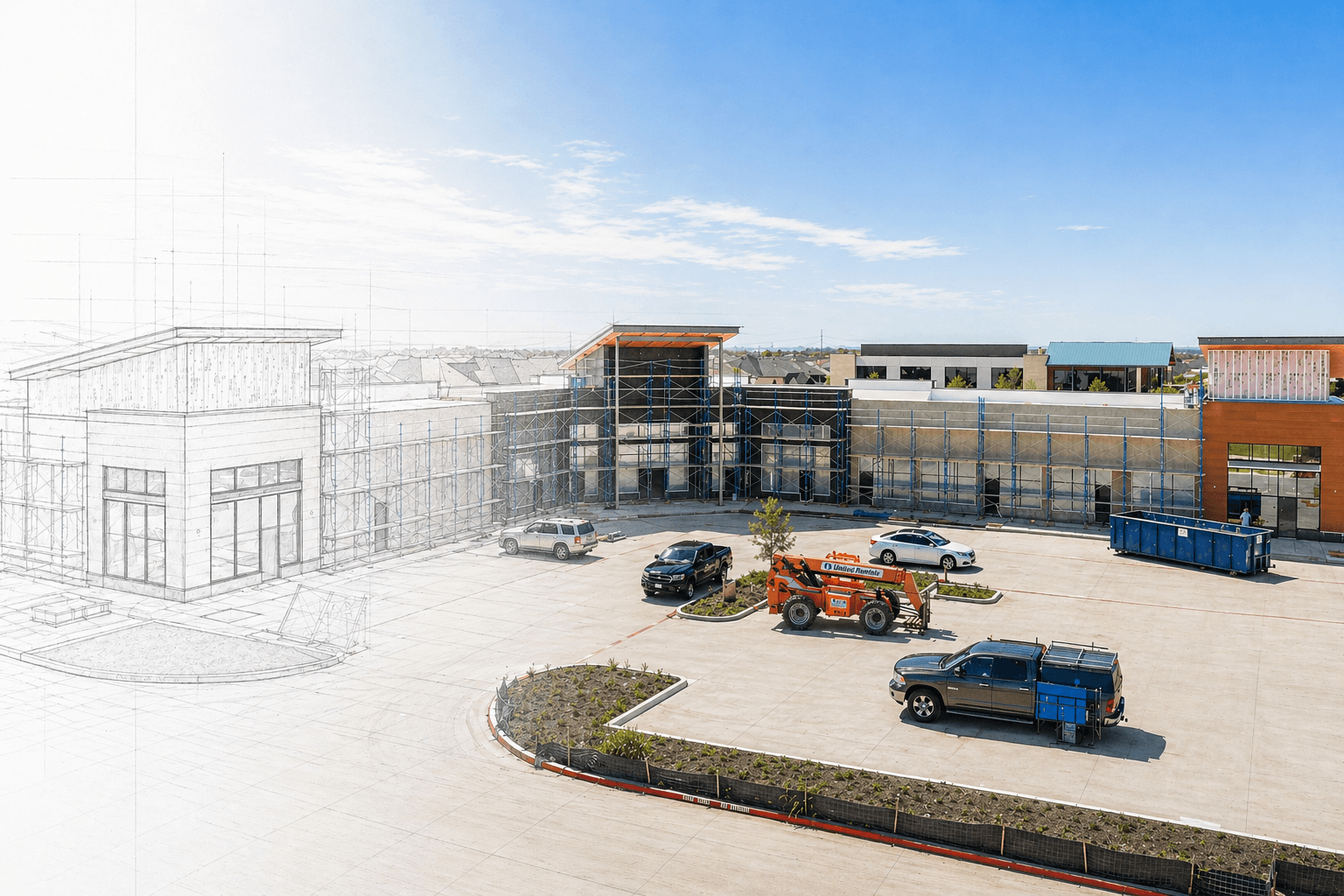

5 Steps to Plan a Commercial Development Project in North Texas
Learn how to plan a commercial development project in North Texas, covering land feasibility, zoning, permits, budgeting, financing, and construction.
Planning a commercial development project in North Texas starts with one honest question: will this building still make sense on the day it opens?
It’s easy to fall in love with a corner lot or a growth headline. However, a project succeeds when the demand, site, approvals, and budget all agree with each other.
The opportunity is real, and so are the risks. A missed floodplain, a slow utility connection, or a skipped state filing can drain months and money.
Fortunately, most of these problems can be spotted early. Here’s how, step by step.
Why North Texas Deserves a Closer Look
First, consider the people. Dallas-Fort Worth added 123,557 residents between July 2024 and July 2025, based on Census estimates.
That was the second-largest gain of any U.S. metro. However, growth slowed from 2.3% to 1.4%, and it wasn’t even. Collin County added nearly 43,000 people, while Dallas County lost about 2,600.
Property types also behave very differently. Here’s where the metro stood in the third quarter (July–September) of 2026:
Property type | Vacancy | Under construction (million sq. ft.) | |
Industrial | 7.8% | 33.9 | |
Office | 24.6% | 3.5 | |
Retail | 5.4% | 7.2 |
In other words, industrial demand is absorbing space, with vacancy down from 8.9% a year earlier.
Retail remains tight, and about 72% of its pipeline is already pre-leased. Office, on the other hand, is improving but still has plenty of empty space.
So, a speculative office building needs a much stronger case than a pre-leased retail center.
Meanwhile, job growth is steady rather than spectacular. The Dallas Fed forecasts 1.1% Texas job growth in 2026, below the long-run average of 2%. Therefore, plan around real demand in your submarket, not statewide optimism.
Step 1: Define Your Goals and Test Feasibility
Before you tour a single site, write down what success looks like. Are you building space for your own business, leasing to tenants, or planning to sell?
Each path changes your design, financing, and tolerance for delay.
Next, study the market at street level. Metro averages are helpful, but tenants choose specific locations. Look at:
Competing supply: What is vacant, under construction, or proposed nearby?
Demand: Who needs this space, and how many have shown real interest?
Achievable rent: What are comparable tenants actually paying, after concessions?
Access: How will customers, employees, and trucks get in and out?
Then build a simple pro forma, which is a forecast of costs, income, and returns. After that, stress-test it.
What happens if construction costs rise 10%, leasing takes six extra months, or your interest rate climbs one point? If the deal only works when everything goes right, it isn’t ready yet.
You can also read: 7 Steps to Choose a Commercial Construction Company in DFW.
Step 2: Choose a Site and Do Your Due Diligence
A lower land price can be misleading.
For example, a cheaper tract that needs a new water line, major grading, or a rezoning may cost more than a ready site.
So, make your purchase contract contingent on a due diligence period that’s long enough to answer these questions.
Environmental history. Order a Phase I Environmental Site Assessment. To help preserve federal liability protections, parts of this review must be completed or updated within 180 days before you acquire the property, and others within one year.
Floodplain. Check FEMA maps early. Additionally, development within the Trinity River Corridor’s regulatory zone generally needs a Corridor Development Certificate before work begins.
Power. This has become a serious schedule risk. At the end of Q3 2026, Oncor reported 795 requests in its large commercial and industrial transmission queue, including about 293 gigawatts from data centers. Even for smaller projects, ask your utility for capacity and timing in writing.
Water, sewer, and roads. Confirm line locations, capacity, driveway access, and who pays for upgrades. Also ask about impact fees, which help fund new infrastructure. Depending on platting and local rules, they may be collected at platting, utility connection, building permit, or occupancy.
Title, survey, and soils. Look for easements and deed restrictions. Likewise, get a geotechnical report, because North Texas clay soils can swell and shrink, which affects foundation design and cost.
You can also read: How Civil Engineering & Site Planning Impact Project ROI in Texas.
Step 3: Map Zoning, Permits, and Compliance
Each North Texas city has its own zoning code, design standards, and review calendar.
Therefore, request a pre-development meeting before you pay for full construction drawings. Ask whether your use is allowed, whether you need a rezoning or plat, and which studies are required.
State law also gives you some timing protections:
Plats: A municipal authority generally has 30 days to approve, conditionally approve, or disapprove a filed plat, with extensions available at the applicant’s request or in limited other cases.
City building permits: Within 45 days, a city must decide, explain in writing why it can’t yet, or agree with you on a deadline.
Third-party review: If an authority misses certain legal deadlines by 15 days, House Bill 14 allows qualified third parties to perform reviews or inspections.
However, these clocks don’t guarantee a fast approval. Incomplete applications and repeated revisions can still stretch your schedule.
Zoning rules have shifted, too. Since September 2025, Senate Bill 840 has allowed qualifying multifamily and mixed-use residential projects in many commercial districts without rezoning.
It applies to larger cities in larger counties, with exceptions. As a result, a commercial site may now have more options, or new residential neighbors.
Finally, don’t overlook these state-level requirements:
Accessibility: Projects costing $50,000 or more must be registered with the Texas Department of Licensing and Regulation. Design professionals generally have 20 days after issuing plans, excluding weekends and holidays, to submit them to an accessibility specialist. Inspection is due within one year of completion.
Stormwater: Disturbing one acre or more generally triggers state permit requirements, including smaller tracts within a larger common development plan. Sites of five acres or more also require a Notice of Intent before discharging stormwater.
You can also read: Land Development in Texas: Zoning, Entitlements & Permits Explained.
Step 4: Build a Realistic Budget and Financing Plan
Your budget should cover far more than construction. Include land, design, engineering, permits, impact fees, utility upgrades, financing costs, property taxes during construction, leasing commissions, tenant improvements, and contingency.
For early screening, one Dallas-Fort Worth cost guide, updated in September 2026, lists these ballpark figures:
Building type | Cost per sq. ft. | Benchmark basis |
Industrial/warehouse | 214–238 | National |
Retail strip center | 309–371 | National |
Single-story office | 238–286 | Dallas area |
For instance, a 50,000-square-foot, single-story office would pencil out at about $11.9 million to $14.3 million at those rates.
Treat that as a starting point, not a quote. A basic warehouse shell can cost less, while specialized interiors can cost much more.
Price movement matters just as much. According to the Associated General Contractors of America, nonresidential construction input costs jumped 13.3% from October 2025 to October 2026. Steel mill products rose 32.9%, and copper and brass shapes rose 23.9%.
Consequently, ask how long each bid is valid, order long-lead materials early, and carry a healthy contingency. Many teams start around 5% to 10%, then adjust for design completeness and site risk.
You can also read: Commercial Construction Insurance and Liability in Texas: What You Should Know.
Financing and incentives
Talk with lenders early about equity, pre-leasing, guarantees, and interest reserves.
If your business will occupy the building, an SBA 504 loan may help. It can’t fund speculative or rental real estate investment.
Incentives may also improve the numbers:
Chapter 380 and 381 programs: Cities and counties can offer economic development loans or grants.
Chapter 312 abatements: Participating local taxing units can abate property taxes for up to 10 years. School districts can’t participate.
JETI: This state program offers a 10-year limit on certain school district taxable values for eligible large projects. In counties with 750,000 or more residents, the thresholds are 75 jobs and $200 million in investment, with some exceptions.
Approach local officials before you commit to a site. Incentives are discretionary, and timing rules apply.
You can also read: MUD, TIRZ & Incentives: 5 Things Developers Should Know in Texas.
Step 5: Assemble Your Team and Set the Timeline
Bring in experienced people early: a broker, civil engineer, architect, general contractor, real estate attorney, lender, and tax advisor.
Then choose how they’ll work together:
Design-bid-build completes the design before contractors bid.
Design-build puts design and construction under one contract.
Construction manager at risk brings the builder in during design, often with a guaranteed maximum price.
Next, create a schedule with clear go/no-go points. These ranges are illustrative planning assumptions for a modest project, so confirm yours with your team:
Phase | Planning range | Decide before moving on |
Feasibility and due diligence | 2–4 months | Is the site viable? |
Design and entitlements | 4–9 months | Can it be approved and funded? |
Permitting and bidding | 2–6 months | Does the price still work? |
Construction | 8–18 months | Is it ready to occupy? |
5 Mistakes to Avoid While Planning a Commercial Development Project in North Texas
Even strong projects can stumble. Watch for these traps:
Closing on land before confirming zoning, utilities, and floodplain status.
Relying on a budget based on early sketches or old bids.
Assuming a growing county guarantees tenants for your building.
Starting design without city feedback.
Treating incentives as guaranteed income.
You can also read: 7 Common Mistakes First-Time Commercial Developers Make.
Conclusion: Plan Carefully, Build Confidently
A successful North Texas development is rarely about moving fastest. Instead, it’s about answering expensive questions while changes are still cheap.
Define your goal, verify demand, investigate the site, confirm approvals, and protect your budget.
Ready to take the next step? Write a one-page project brief with your intended use, building size, preferred location, budget, and target opening date.
Then bring it to your development team and city staff. It’s a small step that can save you from very large surprises.
Contact TX Sparks Construction to discuss your project and request a free budget estimate.
Frequently Asked Questions
1. How long does a commercial development project take in North Texas?
Using the planning ranges above, a modest project could take roughly 16 to 37 months if phases run back to back. Overlapping work can shorten that, while complex approvals can extend it.
2. Do I need a permit for a commercial project outside city limits?
Possibly. County rules, extraterritorial jurisdiction requirements, utility providers, and state permits may still apply. So, confirm jurisdiction first.
3. What is a commercial real estate feasibility study?
A commercial real estate feasibility study evaluates whether a proposed development is financially, physically, and legally viable. It typically examines market demand, land conditions, zoning, infrastructure, construction costs, financing, potential revenue, and investment returns.
4. What should developers check before purchasing commercial land in North Texas?
Before purchasing commercial land, developers should investigate zoning, permitted land uses, floodplain status, environmental conditions, utility availability, road access, easements, title restrictions, soil conditions, and infrastructure costs.
5. How much does commercial construction cost per square foot in North Texas?
Commercial construction costs depend on the building type, design, location, materials, labor, and site conditions. The preliminary September 2026 benchmarks referenced in this article range from $214 to $238 per square foot for industrial or warehouse buildings, $309 to $371 for retail strip centers, and $238 to $286 for single-story office buildings.
6. What permits are required for commercial development in Texas?
Commercial development may require zoning approval, platting, site development permits, building permits, drainage approvals, utility approvals, stormwater permits, accessibility compliance, and fire and safety inspections. Exact requirements depend on the municipality, property, and proposed development.
Disclaimer: This article is provided for general educational and informational purposes only and does not constitute professional, legal, financial, or engineering advice. While TX Sparks Construction makes every effort to keep this content accurate and current, we make no warranties as to its completeness, accuracy, or reliability. Construction codes, regulations, and requirements vary by location and project and are subject to change. Any action you take based on this information is strictly at your own risk. For guidance specific to your project, please consult a qualified professional or contact our team directly.