
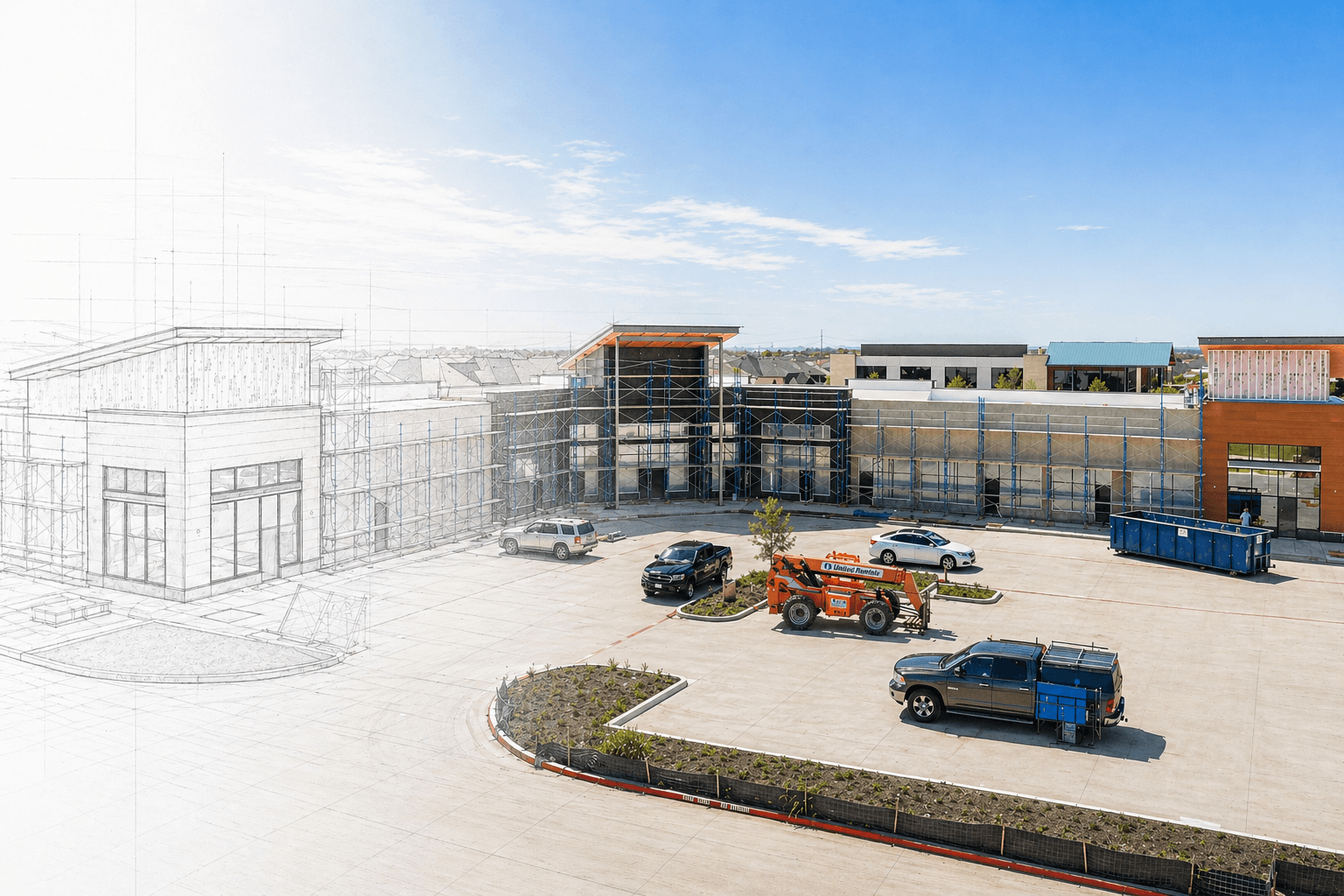

7 Steps to Choose a Commercial Construction Company in DFW
Choose a commercial construction company in DFW by evaluating experience, pricing, project management, communication, local expertise, and past projects.
You have the land, the vision, and (hopefully) the financing. Now comes the decision that will shape everything else: who is going to build it?
In Dallas-Fort Worth, that choice carries more weight than ever. The Metroplex is one of the busiest building markets in the country, which means great contractors are in demand, and so are the mediocre ones.
A strong partner protects your budget, your timeline, and your peace of mind. A weak one can turn an exciting project into an expensive lesson.
The good news is that you can make this decision with confidence.
Below, we cover what is happening in the DFW market, seven steps for vetting a contractor, and the red flags worth walking away from.
Why the DFW Market Makes This Decision Harder
First, some context. DFW is anything but quiet.
According to Yardi Matrix data reported by CRE Daily, Dallas had 103 industrial projects totaling 29.6 million square feet under construction in February 2026.
That equals 2.8% of the market's inventory, compared with a 1.8% national average.
Meanwhile, the region had 2.6 million square feet of office space underway in May 2026, placing it among the top three U.S. office markets by development pipeline.
Retail is just as active. JLL's second-quarter 2026 report shows 95.9 square feet of retail under construction per 100 residents, nearly 40% more than the next-closest market.
Data centers add even more pressure, with total under-construction inventory up 81% between the first halves of 2025 and 2026.
Why does this matter to you? Because sustained volume can affect subcontractor pricing and availability in some trades.
When everyone is building, the contractors with deep trade relationships and disciplined scheduling are the ones who finish on time. Those are the firms you want to find.
You can also read: 10 Top General Contractors in Dallas, Texas (2026 Guide).
Step 1: Get Clear on Your Project Before You Call Anyone
Before you request a single proposal, define what you are building. Contractors can only be compared fairly when they are pricing the same thing.
Write down your building type, approximate size, target budget, desired completion date, and must-have features.
Clarify, too, who on your side has final decision-making authority, because slow owner approvals are a common source of delay.
A Texas benchmark guide suggests adding 18% to 28% for soft costs on top of hard costs. Treat figures like these as early screening tools rather than bids.
Still, they help you spot proposals that look suspiciously low or unrealistically high.
Step 2: Verify Licensing, Insurance, and Legal Standing
Here is something that surprises many first-time owners: Texas does not issue a statewide general contractor license.
Instead, requirements are handled at the city and county level, alongside separate state licensing for certain trades such as HVAC, electrical, and plumbing. In other words, "no state license" does not mean "no rules."
Because the state does not do the vetting for you, you have to. Check what your municipality requires, then ask every candidate for:
Certificates for general liability, umbrella, and commercial auto insurance
Proof of workers' compensation coverage, which most commercial projects expect
Bonding capacity, if your project calls for performance and payment bonds
Required trade licenses and city registrations
A clear history with no pending litigation or liens
Finally, confirm coverage directly with the insurance carrier. A certificate forwarded in an email is not the same as active coverage.
You can also read: Commercial Construction Insurance and Liability in Texas: What You Should Know.
Step 3: Match Experience to Your Asset Type
Not every builder is right for every building. A contractor who excels at tilt-wall warehouses may struggle with a medical office build-out, and the reverse is also true.
Mid-rise and high-rise concrete work, for example, depends on a smaller pool of experienced subcontractors than wood-frame construction does, according to one DFW market overview.
So, ask for projects similar in size, complexity, and location to yours. Familiarity with local codes, municipal permitting, and North Texas soil conditions saves real time.
Ask how many comparable projects the firm completed in the last three years and who actually led them.
If the team behind the impressive portfolio is not the team assigned to you, you should know that before you sign.
DFW's geography adds another wrinkle. Permitting timelines, inspection practices, and design standards can differ between Dallas, Fort Worth, Plano, Frisco, Arlington, and smaller suburbs.
A contractor who has already pulled permits in your city knows what reviewers expect, and that familiarity keeps drawings moving instead of stuck in a resubmittal loop.
You can also read: What Does a Commercial General Contractor Do in Texas?
Step 4: Check Financial Strength and Capacity
A contractor's finances are your risk. A company stretched across too many jobs, or struggling with cash flow, may pay subcontractors late, slow down, or walk away.
Therefore, request financial statements or a bonding letter from their surety.
Also ask about current workload: how many projects are they running, and will yours get senior attention?
Capacity matters because delays are common across the industry.
A May 2026 industry study found that only 33% of contractors start most of their projects on time, and 48% name labor shortages as the top cause of delay.
A contractor who can explain how they secure labor and materials early is already ahead of the pack.
Step 5: Call the References (and Ask Better Questions)
References are only useful if you ask the right questions. Request at least three from recent projects, ideally including one that hit a rough patch.
Every contractor has had one, and how they handled it tells you more than a flawless highlight reel.
When you call, ask:
Did the project finish on time and on budget? If not, why?
How were change orders handled and priced?
How responsive was the project team?
Would you hire this contractor again?
If possible, also speak with architects and subcontractors who have worked with the firm. Subs know which DFW commercial general contractors pay on time and run organized job sites.
Online reviews and local reputation can supplement this research, but a polished website says very little about how a job site actually runs.
You can also read: 10 Questions to Ask a Commercial General Contractor in Texas Before Hiring.
Step 6: Compare Proposals Apples to Apples
Once bids arrive, resist the urge to pick the lowest number.
Instead, line up scope, inclusions, exclusions, allowances, schedule assumptions, and general conditions side by side.
A low bid often means something has been left out, and that gap tends to resurface later as a change order.
Change orders deserve special attention.
In PlanRadar's 2026 survey of 1,728 industry professionals, two out of three said mid-project changes led to overruns on many or most of their projects.
Ask each contractor to explain their change-order process, markup structure, and approval timeline in writing.
You should also consider the delivery method:
Design-build can speed delivery and create a single point of accountability.
Construction manager at-risk brings the contractor in early for pricing and constructability input.
Design-bid-build encourages competitive pricing but offers less early collaboration.
The right choice depends on whether your priority is speed, cost certainty, or control over design.
Finally, read the contract itself before you fall for the handshake. Review the payment schedule and retainage terms, the definition of substantial completion, warranty length, and what happens if the schedule slips.
Many owners start from industry-standard agreement forms, such as those published by the AIA, because lenders, architects, and attorneys already know them. Have your attorney review whatever you sign.
You can also read: Commercial Construction in Fort Worth: Permits to Project Delivery.
Step 7: Evaluate Communication and Preconstruction
The best predictor of a smooth project is often how a contractor behaves before construction begins.
Notice how quickly they respond, how clearly they explain, and whether they ask smart questions about your goals.
Chemistry counts, too. You will be sitting in meetings with these people for a year or more, so choose a team you can be honest with.
Planning also pays off. In the same study mentioned earlier, 79% of respondents said better project planning reduces schedule overruns.
Look for firms that invest in preconstruction: value engineering, early procurement of long-lead items, detailed schedules, and a realistic risk list. Then ask how they will keep you informed.
Weekly reports, shared project dashboards, and regular owner-architect-contractor meetings signal a firm that values transparency.
You can also read: How Commercial General Contractors Manage Projects From Start to Finish.
Red Flags to Watch For Before Hiring a Commercial Construction Company in DFW
Sometimes the clearest answer is knowing what to avoid. Walk away, or at least slow down, if you notice any of these:
Pressure to sign quickly or "lock in" pricing without a defined scope
A bid far below every competitor
Vague contracts, allowances, or exclusions
Reluctance to share insurance, references, or financials
Upfront payment demands well beyond industry norms
Slow or unclear communication during the proposal stage, because it rarely improves once work begins
You can also read:
Where TX Sparks Construction Fits In
If you are building your shortlist, TX Sparks Construction is worth a look.
The company works across Texas commercial construction and cites more than 10 years of experience and 55+ completed projects.
Its services run from land feasibility, land entitlement, and design and permitting through ground-up construction, interior build-out, and construction management, with design-build also offered.
That breadth matters because, as noted in Step 6, early collaboration is where many budget problems get solved.
Moreover, recent work includes Oasis 29, a 45,042-square-foot ground-up retail development in Liberty Hill, and Lexington Square, a 41,560-square-foot commercial development in Frisco.
Also, the firm points to an in-house engineering team, centralized communication and documentation, and insured and bondable status, with bonding subject to project-specific evaluation.
Of course, do the same homework on TX Sparks Construction that you would on any contractor: ask for references, confirm insurance and bonding directly, and compare its proposal line by line.
The good news is that the company offers a free budget estimate and a free consultation, so a first conversation carries little risk.
Conclusion
Choosing among commercial construction companies in DFW comes down to fit, not just price.
The right partner understands your building type, carries the proper insurance, has the capacity to staff your job, and communicates openly when things get complicated, as they inevitably do.
Take your time, verify everything, and use the steps above as a scorecard.
Start by shortlisting three to five firms, then compare them on experience, financial strength, references, and the clarity of their proposals.
Do that, and you will be building with a team you trust in one of the strongest construction markets in the country.
Ready to start your project? Get a free budget estimate or book a free consultation with TX Sparks Construction. Call +1 (469) 598-2558 or email info@txsparks.com. Share your vision, and take the first step toward a build you can trust.
Frequently Asked Questions (FAQs)
1. How do I choose a commercial construction company in DFW?
Verify insurance and bonding, match the firm's experience to your building type, call recent references, and compare bids by scope rather than price alone. Then read the contract carefully, including payment terms, change-order rules, and warranty length, before you sign.
2. Does Texas require a license for commercial general contractors?
No. Texas has no statewide commercial general contractor license, but cities and counties may require registrations and permits. Certain trades, such as HVAC, electrical, and plumbing, do require state licenses. Always check the rules in the city where you are building.
3. How much does commercial construction cost per square foot in DFW?
One 2026 DFW cost guide reports a range of $175 to $605 per square foot, depending on asset type. Tilt-up warehouse shells run $175 to $225, and Class A office runs $280 to $450. A Texas benchmark guide suggests adding 18% to 28% for soft costs.
4. What is the difference between design-build and design-bid-build?
With design-build, one team handles both design and construction, which can speed delivery and simplify accountability. With design-bid-build, the owner hires a designer first and then bids the project to contractors, which encourages competitive pricing but offers less early collaboration.
5. Why do commercial construction projects run late?
Labor shortages, planning gaps, and mid-project changes are common causes. A May 2026 study found only 33% of contractors start most projects on time, with 48% citing labor shortages as the top delay driver. Strong preconstruction planning helps reduce the risk.
6. Does TX Sparks Construction build commercial projects in DFW?
Yes. TX Sparks Construction offers commercial construction services in DFW, including ground-up construction, interior build-out, design and permitting, and construction management. Its website references projects in Frisco, Flower Mound, and other North Texas cities, and it offers free budget estimates and consultations.
Disclaimer: This article is provided for general educational and informational purposes only and does not constitute professional, legal, financial, or engineering advice. While TX Sparks Construction makes every effort to keep this content accurate and current, we make no warranties as to its completeness, accuracy, or reliability. Construction codes, regulations, and requirements vary by location and project and are subject to change. Any action you take based on this information is strictly at your own risk. For guidance specific to your project, please consult a qualified professional or contact our team directly.