
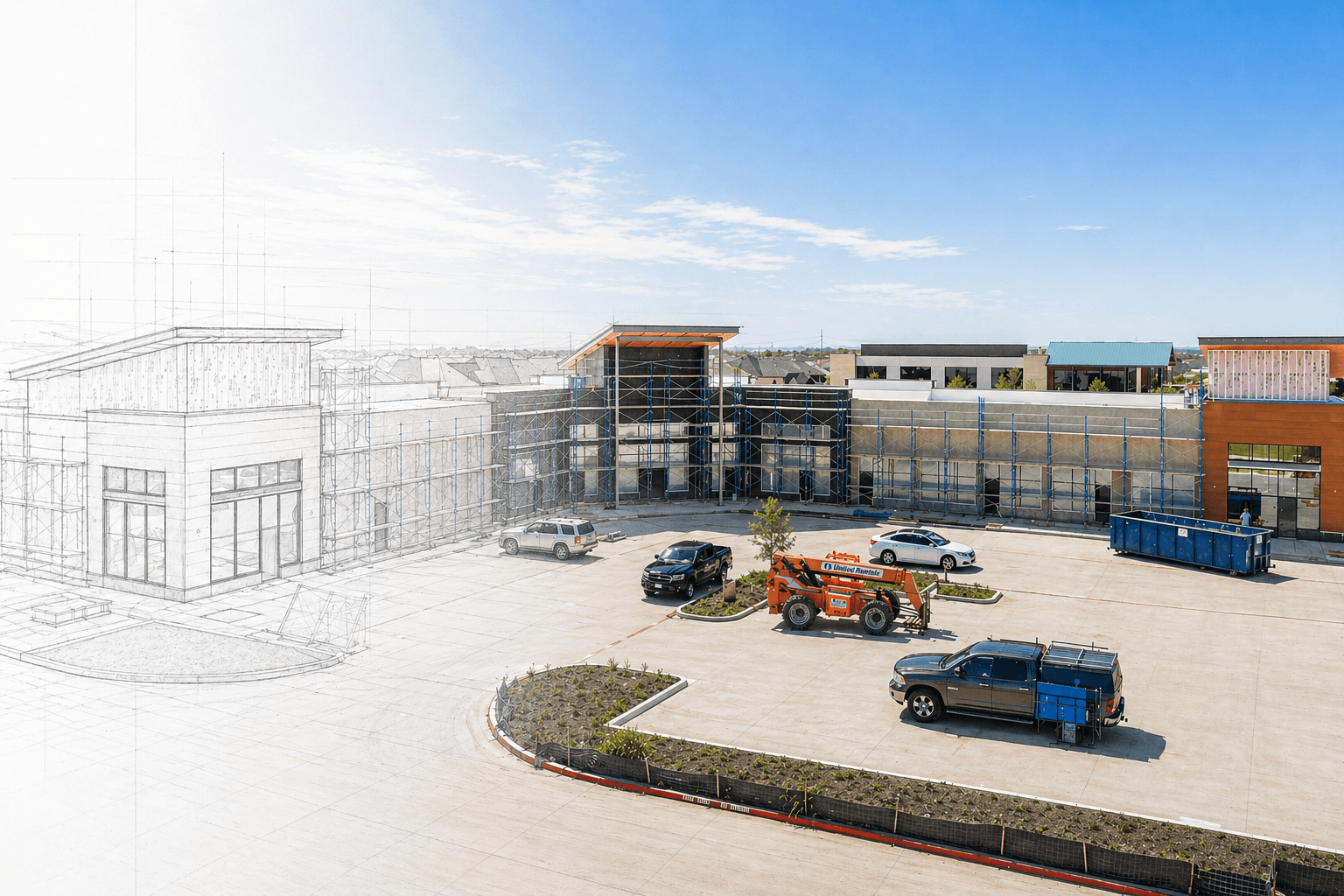

What Does a Commercial General Contractor Do in Texas?
Discover how commercial general contractors in Texas manage construction budgets, permits, subcontractors, schedules, inspections, and project delivery.
If you're planning a new office, clinic, restaurant, or retail space in Texas, one decision shapes almost everything that follows: who will run the build.
In most cases, that's a commercial general contractor (GC).
Yet many owners only learn what a GC actually does after the budget slips or the schedule stalls.
The stakes are high. Texas recorded about $89.7 billion in annual commercial construction spending, more than double that of any other state. With that much money moving, understanding the GC's role isn't optional.
So, let's walk through what a commercial general contractor in Texas does, how the work looks, and what to know before you hire one, including how firms like TX Sparks Construction approach the job.
What Is a Commercial General Contractor?
A commercial general contractor takes overall responsibility for building a non-residential project, such as an office, school, restaurant, or retail center.
The owner hires the GC, and the GC hires and manages everyone else: subcontractors, suppliers, and the day-to-day schedule.
Think of the GC as the conductor of an orchestra. Electricians, plumbers, and concrete crews are all skilled musicians.
However, without someone keeping time, the result is noise. The GC provides that coordination and, just as importantly, carries the risk when something goes wrong.
You can also read:
Why Texas Is a Unique Market
Texas isn't an ordinary construction market, and that shapes what GCs do here every day.
First, the scale is remarkable. The state employs roughly 876,600 construction workers, the most in the country, after adding about 15,700 jobs in the past year. Second, data centers are changing the landscape.
Texas data-center construction starts totaled $11 billion in the 12 months through November 2025, and Google announced plans to invest $40 billion in new AI data centers in the state.
Growth isn't limited to data centers, either. Restaurants, medical suites, retail centers, and offices continue to rise across Dallas-Fort Worth and Central Texas, which is where firms like TX Sparks Construction are building.
Because of this growth, Texas GCs must juggle fast schedules, tight labor markets, and complex technical requirements.
Consequently, the best contractors here are as much project strategists as builders.
You can also read: 7 Common Mistakes First-Time Commercial Developers Make.
The Core Responsibilities of a Commercial General Contractor
1. Preconstruction Planning
The work begins long before groundbreaking. The GC reviews plans, studies the site, prepares a cost estimate, and builds a realistic schedule.
Value engineering, which means finding smarter materials or methods that protect your design while reducing cost, often happens here.
In other words, a good GC saves you money before construction even starts.
You can also read: Understanding Preconstruction Services: Why Early Planning Saves Millions.
2. Managing Subcontractors
A GC rarely performs every trade in-house. Instead, they solicit bids, vet subcontractors, and manage crews on site.
This is where experience matters most, because one weak subcontractor can delay every trade that follows.
Texas adds a licensing layer, since the Texas Department of Licensing and Regulation (TDLR) licenses electrical, plumbing, and HVAC trades.
A careful GC verifies those credentials before work begins.
3. Permits, Codes, and Inspections
Every commercial project must satisfy building codes, zoning rules, and inspections.
In Texas, those rules are largely set by cities and counties, so the process in one city can look very different from the next.
The GC handles permit applications, schedules inspections, and responds to plan-review comments.
Therefore, a contractor who knows the local jurisdiction can often keep approvals moving.
You can also read: DFW Commercial Construction Permitting: The Complete Guide.
4. Budget and Schedule Control
Once construction starts, the GC becomes the financial hub. They track costs, process pay applications, and manage change orders when scope shifts.
With tariffs, material costs, and elevated interest rates pressuring parts of the private market, accurate forecasting matters more than ever.
You can also read: Commercial Construction Insurance and Liability in Texas: What You Should Know.
5. Safety and Quality Control
The GC creates the site safety plan, enforces OSHA requirements, and inspects completed work against the drawings.
Catching a problem behind a wall costs far less than fixing it after opening day.
6. Project Closeout
Finally, the GC brings the project across the finish line with the punch list, final inspections, certificate of occupancy, warranties, and as-built drawings.
A smooth closeout means you can open your doors with confidence.
You can also read: How Long Does a Commercial Interior Build-Out Take in Texas?
Choosing How Your Project Is Delivered
Another part of the GC's role is helping you pick a delivery model. Three approaches are common:
Design-bid-build: The owner finishes the design first, then bids it to contractors. It's familiar and competitive, but the GC joins late.
Construction manager at-risk: The GC joins during design and commits to a guaranteed maximum price.
Design-build: One team handles both design and construction, which can shorten the schedule and simplify accountability.
The right choice depends on how well-defined your scope is, how much risk you want to carry, and how quickly you need to open.
You can also read: 8 Ways to Deliver a Commercial Building with Zero Change Orders.
Do Commercial General Contractors Need a License in Texas?
This question surprises many people. Texas does not issue a statewide general contractor license, so requirements vary by city and county.
For instance, Houston doesn't require one, while Dallas does have licensing requirements.
Meanwhile, electrical, plumbing, and HVAC work requires state licenses through TDLR everywhere.
Because the state doesn't set a minimum bar, you need to set one yourself. Before signing a contract, verify the following:
Local registration or licensing where your project is located
Proof of general liability, workers' compensation, and commercial auto insurance
State licenses held by key trade subcontractors
Bonding capacity, especially for larger projects
Licensing rules can change, so confirm current requirements with your city or county before you hire.
The Labor Challenge Every Texas GC Faces
Nationally, the industry needs about 349,000 new workers in 2026 to balance labor supply and demand, and Texas feels that shortage in nearly every trade.
Moreover, the Dallas Fed reports that 53 percent of Texas construction trades workers were foreign-born in 2024, so labor availability can directly affect schedules and costs.
This is where a strong GC earns their fee: contractors with long-standing subcontractor relationships are more likely to secure crews when demand spikes.
Meet TX Sparks Construction: An End-to-End Commercial Contractor in Texas
Now, let's look at how this plays out in practice. TX Sparks Construction describes itself as an end-to-end commercial construction company in Texas.
What sets us apart is how early we get involved. Our services span the full project lifecycle:
Land feasibility and land entitlement: evaluating a site's regulatory constraints, infrastructure, and financial viability before design begins
Design and permitting: coordinating with architects, engineers, and municipalities through regulatory approval
Ground-up construction: taking raw land through site preparation, structure, and final delivery
Interior build-out: converting shells into finished spaces for offices, retail, hospitality, and medical suites
Construction management: providing a single point of accountability from concept through close-out
Land development and MUD & PID services: supporting infrastructure and district formation for larger developments
Moreover, our portfolio reflects that range. Listed projects include the Lexington Square ground-up development in Frisco, interior build-outs in Frisco, McKinney, and Richardson, and ground-up work in Lewisville, Leander, and Cedar Park.
You can also read: General Contractor vs. Construction Manager vs. Design-Build Firm.
How to Choose the Right Commercial General Contractor
With so much at stake, choosing a GC deserves a structured approach. Ask these questions:
Have you built projects like mine? Request examples of similar size and type.
Can I speak with recent clients? References reveal how a contractor handles problems.
How do you communicate? Look for regular reporting and transparent cost tracking.
How do you manage change orders? Clear processes prevent surprises.
Importantly, don't choose on price alone. The lowest bid sometimes leaves out scope that appears later as change orders.
You can also read: 10 Questions to Ask a Commercial General Contractor in Texas Before Hiring.
Conclusion
So, what does a commercial general contractor do in Texas?
They plan the work, assemble the team, manage the money, navigate local regulations, and stand accountable for the result.
In a market this large and fast-moving, that role matters more than ever.
Ready to start your Texas commercial project? TX Sparks Construction offers a free construction cost estimate and a 30-minute consultation through its website. You can also call +1 (469) 598-2558 or email info@txsparks.com to discuss your project.
Frequently Asked Questions
1. What does a commercial general contractor do in Texas?
A commercial general contractor manages a non-residential build from planning to closeout. They estimate costs, hire and supervise subcontractors, obtain permits, control the budget and schedule, enforce safety standards, and deliver the finished project.
2. Do you need a general contractor license in Texas?
No. Texas has no statewide general contractor license, but some cities and counties set their own requirements. Electrical, plumbing, and HVAC trades do require state licenses through TDLR.
3. What is the difference between a general contractor and a construction manager?
A general contractor typically builds the project and holds the trade contracts. A construction manager coordinates the process, often joining during design to advise on cost, schedule, and risk. Some firms, including TX Sparks Construction, offer construction management services in Texas.
4. What services does TX Sparks Construction offer?
TX Sparks Construction offers land feasibility, land entitlement, design and permitting, ground-up construction, interior build-out, land development, MUD and PID services, and construction management for commercial projects in Texas.
5. How do I choose a commercial general contractor in Texas?
To choose a commercial general contractor in Texas, verify local licensing and insurance, review similar past projects, speak with recent clients, and compare proposals line by line rather than by price alone.
Disclaimer: This article is provided for general educational and informational purposes only and does not constitute professional, legal, financial, or engineering advice. While TX Sparks Construction makes every effort to keep this content accurate and current, we make no warranties as to its completeness, accuracy, or reliability. Construction codes, regulations, and requirements vary by location and project and are subject to change. Any action you take based on this information is strictly at your own risk. For guidance specific to your project, please consult a qualified professional or contact our team directly.