
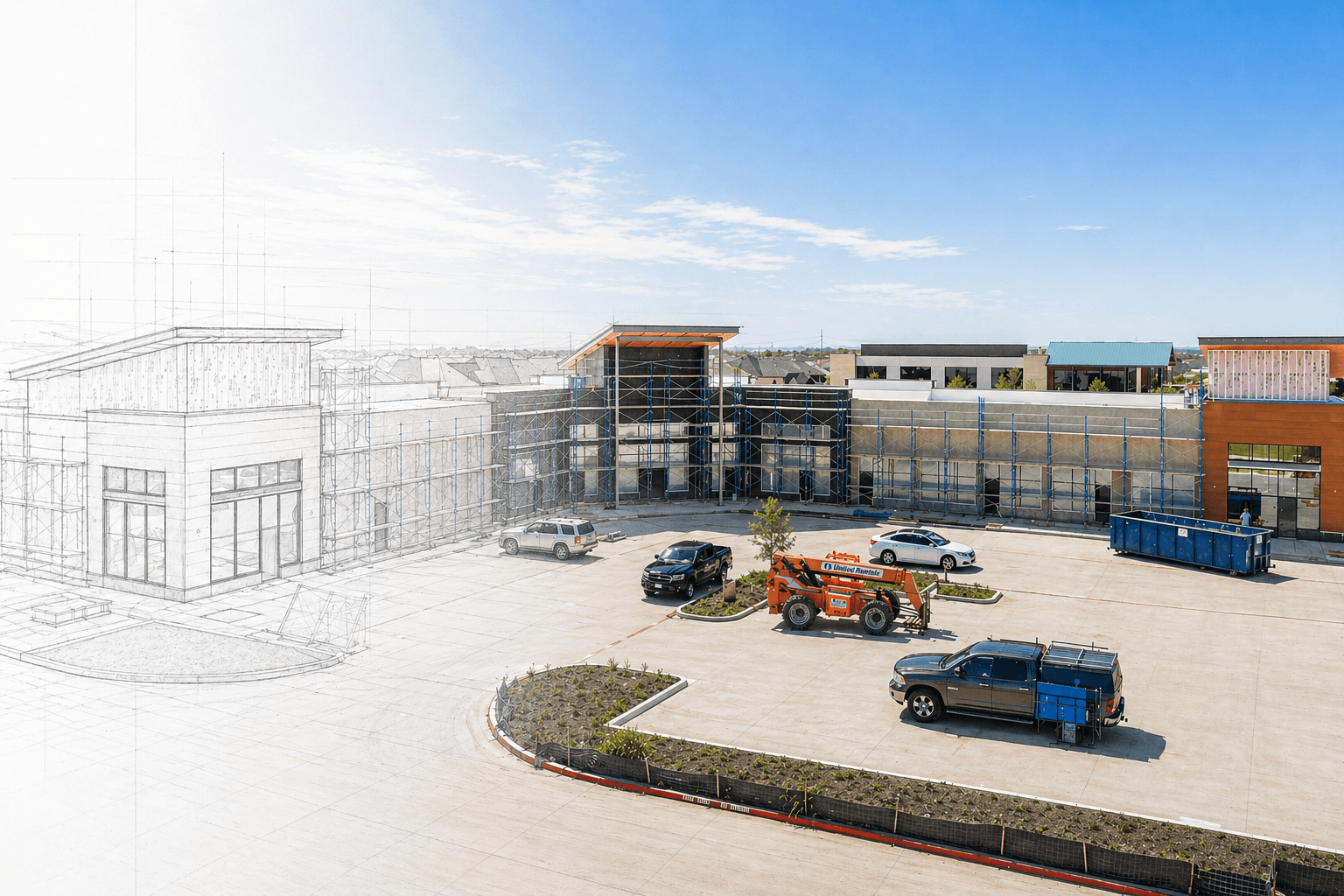

DFW Commercial Construction Permitting: The Complete Guide
Learn how commercial construction permitting works in DFW, including zoning, inspections, fees, approvals, and certificates of occupancy.
If you have ever watched a construction schedule slip because a permit was stuck in review, you already know the truth: in Dallas-Fort Worth, paperwork can cost as much as bad weather.
Every week of delay means carrying costs, idle crews, and a later opening date.
The good news is that permitting is predictable once you understand how it works.
In this guide, we will walk you through the permits you need, the order in which to pursue them, how the major DFW cities differ, and what you can do to avoid the most common delays.
Why Permitting Matters So Much in DFW
First, consider the scale.
According to Census Bureau Vintage 2025 estimates, the Dallas-Fort Worth metro added roughly 123,000 residents in a single year, which ranked it second nationally, just behind Houston.
Meanwhile, Fort Worth now ranks as the 10th-largest city in the country, with about 1.03 million residents after adding 19,512 people in one year.
Farther out, Celina grew 24.6% to 64,427 residents, making it the fastest-growing city in the nation.
As a result, municipal permitting offices are handling heavy volume while developers race to build retail, medical, industrial, office, and multifamily space to keep up with demand.
The stakes are real. A widely cited 2021 analysis of Dallas permitting problems estimated that a three-month delay in commercial permits represented about $31 million in lost tax revenue for the city.
If delays hurt a city's budget that much, imagine what they do to a single project's pro forma.
In short, permitting is not just a compliance exercise. It is a schedule and cost-control strategy.
The Big Picture: What "Permitting" Actually Includes
Many first-time developers assume there is one permit. In reality, a commercial project is a bundle of approvals that overlap.
Here is how they typically break down.
1. Land-use and site approvals
Before anyone reviews your building plans, the property itself has to be eligible for what you want to build. Depending on the site, this may include:
Zoning verification (and a zoning change or special use permit if your use is not allowed by right)
Platting (a new plat or replat if the lot is not already legally subdivided for your use)
Site plan or development plan review
Civil engineering review for grading, drainage, paving, water, and sewer
Floodplain and tree-preservation reviews, where applicable
Because these steps often determine whether the project can move forward at all, smart owners start here during due diligence, not after closing.
2. Building permits
This is the core approval for new construction, additions, and major remodels.
The city reviews your architectural, structural, mechanical, electrical, plumbing, and energy drawings against the adopted building codes.
Many DFW cities currently work from the 2021 International Codes with local amendments, but you should always confirm the exact edition and amendments with your city before design is finalized.
3. Trade permits
Electrical, mechanical, and plumbing work is generally permitted separately by licensed trade contractors.
In Dallas, for example, these permits are distinct from the main building permit and must be pulled by the licensed trades.
4. Fire review
Fire marshal or fire prevention review typically covers sprinkler systems, fire alarms, fire lane access, hydrant placement, and other life-safety items.
In Fort Worth, for instance, fire code plan review has its own published first-review standard.
5. Specialty approvals
Depending on your use, you may also need:
Health department permits for restaurants, daycares, and similar uses
Sign permits
Grease trap or pretreatment approvals for food-service tenants
Texas Accessibility Standards (TAS) registration with the state for qualifying projects (generally those costing $50,000 or more)
Stormwater coverage under the state's construction general permit when you disturb an acre or more of land
6. Certificate of Occupancy
Finally, the Certificate of Occupancy (CO) confirms the finished space is safe and legal to use.
No CO, no customers. Therefore, you should plan for it from day one, not as an afterthought.
You can also read: What Is an Interior Build-Out? A Complete Guide
Step-by-Step: How a DFW Commercial Permit Moves from Idea to Approval
Although each city has its own quirks, most projects follow this general path.
Step 1: Confirm zoning and entitlements.
Start by verifying that your intended use is permitted.
If it is not, build a zoning timeline into your schedule, because those cases can take months.
Step 2: Hire your design team.
Commercial projects in Dallas require plans stamped by licensed architects and engineers, and the same is broadly true across the region.
Experienced local professionals who know each city's expectations can prevent weeks of comments.
TX Sparks Construction supports this step through its design and permitting service, which coordinates architects, engineers, and consultants so scope, schedule, and budget stay aligned.
Step 3: Hold a pre-development meeting.
This is one of the highest-return hours you will spend.
Fort Worth, for example, offers pre-development conferences designed to help applicants understand the process and troubleshoot issues before they submit. Cities generally welcome these conversations because clean submittals are easier for them, too.
TX Sparks Construction's permitting strategy includes leading regulatory meetings and acting as the primary liaison with city and county agencies.
Step 4: Prepare a complete submittal.
Use the city's current checklist. Incomplete applications are one of the most common reasons reviews stall, so check every item before you upload.
Step 5: Apply through the city's online portal.
Dallas requires applications through DallasNow, which launched May 5, 2025, and replaced the legacy system.
Fort Worth commercial applications are filed through Accela Citizen Access.
Step 6: Respond to review comments.
Plan reviewers from multiple departments will mark up your drawings.
Answer every comment completely and resubmit quickly, because incomplete responses trigger another round.
Step 7: Pay fees and receive the permit.
Once all departments approve, you pay the remaining fees and the permit is issued.
Step 8: Build, inspect, and close out.
Schedule inspections as work progresses, coordinate special inspections, and request your final inspections and CO when construction wraps.
You can also read: What Is an Interior Build-Out? A Complete Guide
City-by-City: How Dallas and Fort Worth Compare
DFW is not one permitting market. It is dozens of them. Here is a snapshot of the two anchor cities.
Dallas
Portal: DallasNow, the city's unified planning and development portal, used for building permit and Certificate of Occupancy applications.
Department: Planning & Development, formed in June 2024 when Planning & Urban Design combined with Development Services.
Expedited options: Dallas offers an expedited review path through its Q-Team and a Minor Commercial 2nd Q-Team for projects that meet specific criteria.
Typical timeline: Industry sources commonly cite roughly 4 to 8 weeks for commercial permits when documentation is complete. Treat that as a planning estimate, not a guarantee.
Helpful tool: The city publishes a Commercial Permit Activity Dashboard showing monthly commercial permit output.
Dallas has spent several years working to improve reliability, and the new portal is part of that effort. Even so, complex projects can still run longer, so build contingency into your schedule.
You can also read: 8-Step Ground-Up Construction Process in Texas
Fort Worth
Portal: Accela Citizen Access, through which commercial new construction applications must be filed online.
Department: Development Services.
Expedited option: The Expedited Plan Review Team (X-Team), launched in January 2019, which has fast-tracked reviews for restaurants, multifamily buildings, medical offices, and warehouses. According to local reporting, the X-Team provides full plan review comments within 10 business days.
Published goals: The city's budget targets 95% of building permit initial reviews completed within 5 business days. Separately, earlier budget figures showed average review times for projects of $1 million or more of roughly 23 to 26 days.
Typical timeline: Third-party sources estimate 4 to 12 weeks overall, depending on scope, backlog, and the number of correction rounds.
Fort Worth has long been known for a comparatively responsive permitting culture, and its numbers help explain why developers continue to flock to Tarrant County.
That said, speed still depends on submittal quality.
The Suburbs: Plano, Frisco, Irving, Arlington, Denton, McKinney, and Beyond
Each suburb runs its own department, portal, fee schedule, and review standards.
Some are famously business-friendly; others are stricter on design standards, landscaping, and façade materials.
Because these rules vary so much, always do two things before design is final: read the city's current commercial checklist and schedule a pre-submittal meeting.
TX Sparks Construction has worked across several North Texas communities, including a 41,560-square-foot ground-up development in Frisco, a Paris Baguette build-out in Flower Mound, and a townhome community in Little Elm.
Each city brought its own checklist, so local knowledge made a measurable difference in how smoothly applications moved.
You can also read: Understanding Preconstruction Services: Why Early Planning Saves Millions
Realistic Timelines and Budget Expectations
It helps to separate review time from total permitting time.
Phase | What it covers | Planning range* |
Entitlements | Zoning, platting, site plan | Weeks to many months |
Plan review | Building, fire, civil, health | Roughly 4 to 12 weeks, depending on city and complexity |
Corrections | Responding to comments and resubmitting | Add 1 to 3 weeks per round |
Inspections | Ongoing through construction | Varies by pace of work |
CO issuance | Final inspections and close-out | Days to a few weeks |
These ranges blend city-published goals and industry estimates. Your project may differ.
As for costs, commercial permit fees typically depend on project valuation, square footage, and permit type.
Beyond the building permit itself, budget for plan review fees, trade permits, fire review fees, re-inspection fees, and, depending on the site, impact fees and water and sewer tap fees.
Because each city updates its schedule periodically, download the current fee schedule before finalizing your budget.
You can also read: 10 Questions to Ask a Commercial General Contractor in Texas Before Hiring
A Texas Law Worth Knowing: Third-Party Review and Inspections
Here is a development many owners overlook.
Since September 1, 2023, Texas law (House Bill 14, codified in Chapter 247 of the Local Government Code) has allowed applicants to use qualified third-party reviewers and inspectors when a city misses its review or inspection deadlines.
In general terms, if the city has not issued an approval, conditional approval, or denial within 30 days, a third-party review may proceed 15 days later. Results must be delivered to the city within 15 days of completion.
In 2025, lawmakers followed up with Senate Bill 1450, effective September 1, 2025, which clarified that third-party review applies to development permits and inspections.
Under that bill, a required inspection that the city does not conduct by the 15th day after its prescribed date may be performed by a qualified third party.
What does this mean for you? First, it gives you leverage when a review drags on.
Second, it is not a magic wand, because the rules include specific qualifications and procedures. Therefore, talk with your attorney or permit consultant before relying on it.
You can also read: General Contractor vs. Construction Manager vs. Design-Build Firm
The Most Common Reasons DFW Permits Get Delayed
After years in this space, the same culprits show up again and again.
Incomplete applications. Missing documents mean the clock may not even start.
Code or amendment mismatches. Designing to the base code and missing a local amendment forces redesign.
Zoning surprises. A use that looked allowed turns out to require approval.
Poor coordination between disciplines. Architectural, structural, and MEP drawings that conflict generate long comment lists.
Slow responses to comments. Every day your team waits to respond is a day the project sits idle.
Utility and civil issues. Water, sewer, drainage, or fire-flow problems often surface late.
Scope changes after submittal. Revisions mid-review can send you back to the start of the line.
Fortunately, nearly all of these are preventable.
That is why TX Sparks Construction builds a permitting strategy into the earliest planning phase, rather than treating it as a late-stage task.
You can also read: Commercial Construction Insurance and Liability in Texas: What You Should Know
12 Practical Tips to Get Approved Faster
Start early. Begin permitting research during due diligence, not after you close on the land.
Meet the city first. Pre-development and pre-submittal meetings save rounds of comments.
Use the current checklist. Cities update them, and old versions cause rejections.
Hire local experts. Architects, engineers, and expediters who work in each city daily know what reviewers expect. A general contractor with in-house design and permitting support, such as TX Sparks Construction, can bring those voices together early.
Run an internal QA review. Have someone check that all sheets, calculations, and forms agree before upload.
Ask about expedited programs. Dallas's Q-Teams and Fort Worth's X-Team exist for qualifying projects.
Submit in parallel when allowed. Civil, building, fire, and health reviews can often overlap.
Respond to comments in a single, organized package. Number your responses to match the reviewer's comments.
Track everything. Log submittal dates, comment dates, and response dates so you can spot delays and use them if third-party options come into play.
Coordinate special inspections early. Schedule testing and inspection agencies before construction starts.
Plan your CO from day one. List every final sign-off you will need, from fire to health to utilities.
Build in contingency. A schedule with no buffer is a wish, not a plan.
You can also read: Retail Store Build-Out in Texas: A Complete Guide
Pre-Submittal Checklist
Before you click "submit," confirm that you have the following:
Zoning and use confirmation
Survey and, if needed, plat
Sealed architectural and engineering drawings
Civil plans, drainage, and utility layouts
Fire protection plans (sprinkler and alarm, as applicable)
Energy compliance documentation
Contractor registrations and licensed subcontractor information
TAS registration, if the project qualifies
Stormwater plan and state coverage, if you disturb an acre or more
Health, grease trap, or sign applications, if applicable
Fee payment method ready
You can also read: 8-Step Ground-Up Construction Process in Texas
How TX Sparks Construction Helps You Navigate DFW Permitting
TX Sparks Construction is an end-to-end construction company founded in 2016 by Ravi Polishetty.
We have 10+ years of experience, 55+ successful projects, and services that span ground-up construction, interior build-outs, and land development across Texas.
Because permitting sits at the center of every schedule, TX Sparks Construction offers a dedicated Design and Permitting service. According to the company, it covers five areas:
Kickoff and scoping: consultations and kickoff meetings, a defined project scope, and a clear communication framework and timeline.
Consultant hiring and management: identifying the right consultants, setting scopes aligned with your budget, and serving as your primary liaison.
Design development: coordination among architectural, civil, and design teams, plus ongoing value engineering to protect budget and schedule.
Permitting strategy: compliant application materials, regulatory meetings with city and county agencies, responses to agency comments, and permit tracking.
Coordination during construction: communicating permit conditions to the field team and managing design or permit revisions as work progresses.
Upstream and downstream services matter, too. Before permits, Land Feasibility, Land Entitlement, and MUD & PID Services help clarify whether a site works.
After approval, Ground-Up Construction, Interior Build-Out, and Construction Management carry the project to completion. As a result, one team stays accountable from feasibility to final delivery.
What This Looks Like in Practice
Lexington Square, Frisco: a 41,560-square-foot ground-up commercial development, whose completion was celebrated on August 17, 2026.
Paris Baguette, Flower Mound: a 2024-2025 build-out that, according to the client, had to meet the brand's strict construction and quality standards.
Little Elm townhome community: a client credited the team with guiding them through design, land development, and communications and negotiations with the City.
Clients are also vocal about communication.
The company displays a 5.0 rating across 16 Google reviews as of October 2026, and several reviewers highlight responsive site managers and the Super Construct app for tracking project progress.
You can also read: 11 Things Developers Should Know Before Starting a Commercial Build in DFW
Conclusion
DFW is one of the most exciting construction markets in the country.
However, opportunity comes with process, and the owners who win are the ones who treat permitting as a core part of project planning.
To recap, start with zoning and entitlements, meet with the city early, submit complete and coordinated plans, respond to comments quickly, and use every tool available, from expedited review teams to third-party options.
Do those things consistently, and you will not only reduce risk but also open your doors sooner.
Ready to Start Your DFW Commercial Project?
Permitting does not have to be the part of your project that keeps you up at night.
With early planning, complete submittals, and a team that knows the local process, you can move from approval to groundbreaking with far fewer surprises.
TX Sparks Construction can support you from feasibility and design through permitting, construction, and final delivery. Take the next step today and book a free consultation.
Let's get your project permitted, built, and open for business.
Frequently Asked Questions
1. What permits do I need to build a commercial building in Dallas-Fort Worth?
Most projects need a building permit, separate trade permits for electrical, mechanical, and plumbing, and fire review. Depending on the site and use, you may also need zoning approval, platting, civil review, health or sign permits, and a Certificate of Occupancy before opening.
2. How do I apply for a commercial building permit in Fort Worth?
Commercial new construction permits in Fort Worth must be filed online through Accela Citizen Access. Start by downloading the city's current checklist, then upload complete, sealed plans and pay the initial fees.
3. How much does a commercial building permit cost in DFW?
Fees vary by city and typically depend on project valuation, square footage, and permit type. Budget separately for plan review, trade permits, fire review, re-inspections, and possible impact or utility tap fees. Always check the city's current fee schedule.
4. How long does it take to get a commercial building permit in Dallas?
Industry sources commonly estimate 4 to 8 weeks in Dallas when documentation is complete. Entitlements, such as zoning or platting, and correction rounds can extend that timeline, so build in contingency.
5. Can a third party review my commercial plans in Texas?
Yes, in certain situations. Under Texas Local Government Code Chapter 247, applicants may use qualified third-party reviewers or inspectors if the city misses its deadlines. Talk with your attorney or permit consultant before relying on it.
6. Why do commercial permits get rejected or delayed in DFW?
The most common causes are incomplete applications, missed local code amendments, zoning surprises, conflicts between architectural and engineering drawings, slow responses to reviewer comments, and late utility or civil issues.
7. What is the difference between a building permit and a Certificate of Occupancy?
A building permit authorizes construction. A Certificate of Occupancy confirms the finished building is safe and approved for its intended use. You generally cannot open to the public without it.
8. Does TX Sparks Construction help with commercial permitting in DFW?
Yes. TX Sparks Construction offers a design and permitting service that includes permitting strategy, coordination of application materials, liaison with city and county agencies, regulatory meetings, responses to agency comments, and permit tracking.
Disclaimer: This article is provided for general educational and informational purposes only and does not constitute professional, legal, financial, or engineering advice. While TX Sparks Construction makes every effort to keep this content accurate and current, we make no warranties as to its completeness, accuracy, or reliability. Construction codes, regulations, and requirements vary by location and project and are subject to change. Any action you take based on this information is strictly at your own risk. For guidance specific to your project, please consult a qualified professional or contact our team directly.