
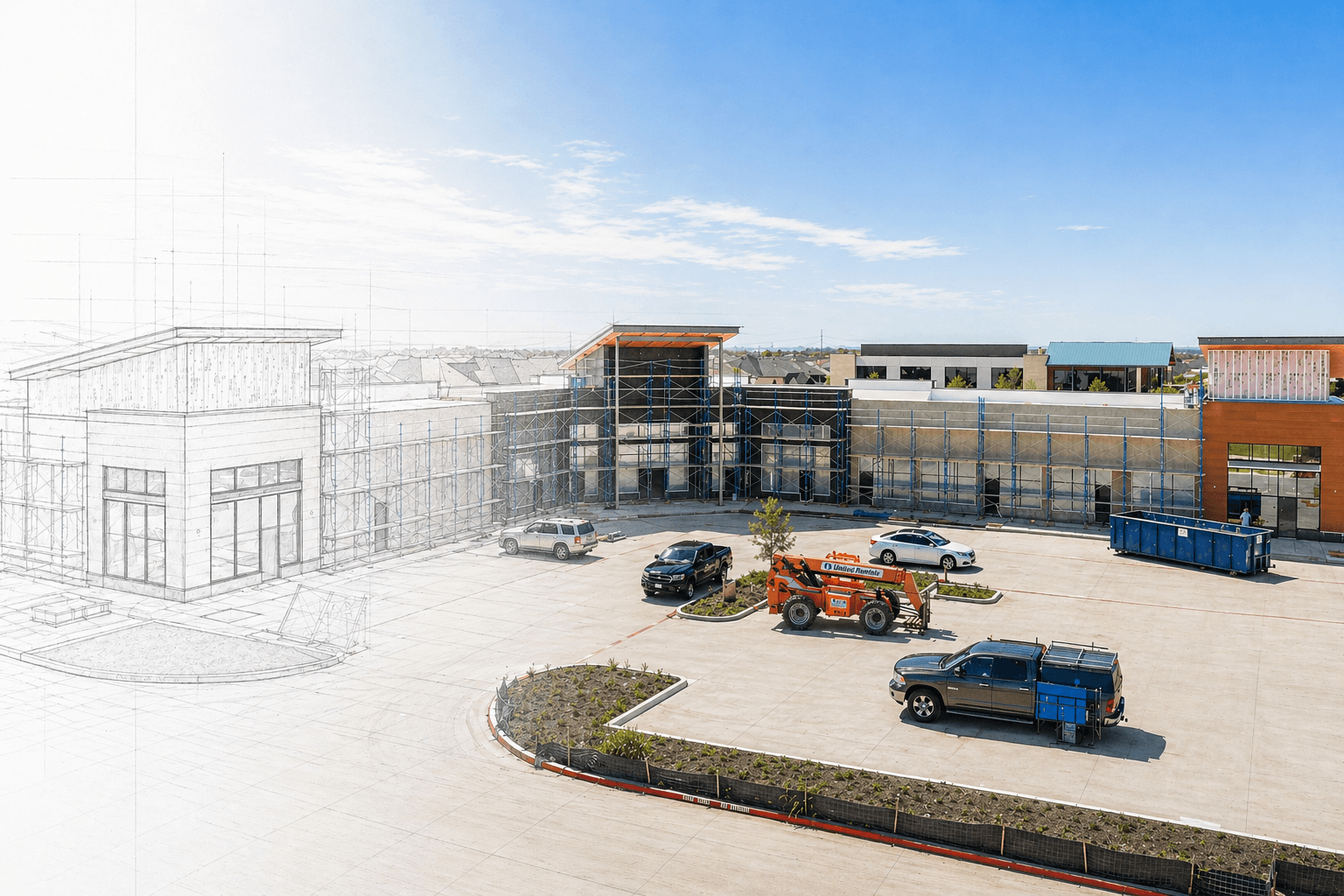

How Commercial General Contractors Manage Projects From Start to Finish
Commercial general contractors manage projects from start to finish, including planning, budgeting, permits, scheduling, construction, and handover.
Every commercial building starts with the same promise: finished on time, on budget, and built to spec. Keeping that promise is harder than it sounds.
A McKinsey analysis of more than 500 large-scale projects found average cost overruns of 79% and delays averaging 52% against original timelines.
That is why owners lean so heavily on their general contractor (GC).
So what does a good GC actually do between the first meeting and the ribbon-cutting?
Below, we walk through each phase of commercial project management, show where projects tend to go wrong, and explain how TX Sparks Construction approaches the same challenges.
Phase 1: Preconstruction, Where Most Projects Are Won or Lost
If you take away one idea from this article, let it be this: the work done before anyone breaks ground matters more than almost anything that happens after.
Overruns are rarely one dramatic failure. They are more often the compounded result of small early decisions, such as unrealistic timelines, incomplete scope definitions, and fragmented information.
That is why strong GCs invest heavily in preconstruction. They typically:
Define the scope clearly with the owner, architect, and engineers.
Run feasibility and site studies, since soil, utilities, zoning, and access all affect cost and schedule.
Conduct constructability reviews to catch drawing conflicts while they’re still cheap to fix.
Explore value engineering to cut cost without cutting quality.
Scope discipline deserves special attention. The Project Management Institute reports that scope changes contribute to cost overruns in 52% of construction projects.
A well-defined scope is therefore one of the cheapest forms of insurance an owner can buy.
This is also where TX Sparks Construction begins. Its services start well before construction, with land feasibility, land entitlement, and design and permitting, so the major questions are answered before the first shovel hits the ground.
You can also read: Understanding Preconstruction Services: Why Early Planning Saves Millions.
Phase 2: Estimating and Building a Realistic Budget
Next comes the budget, and this is where optimism becomes dangerous. Many projects start with projections that ignore real-world complexity.
A seasoned GC builds estimates from detailed takeoffs, current supplier pricing, and subcontractor input rather than rough square-foot averages.
Just as importantly, they plan for change. A Procore-commissioned IDC survey of more than 500 project owners found an average of six budget changes and five schedule changes per project, which raised average project cost by 15 percent.
Because change is the norm, good contractors build in contingency and explain exactly how those funds will be used.
If you’re still in the early budgeting stage, TX Sparks Construction offers a free Cost Estimator on its website to help you set realistic expectations before committing.
You can also read: Infrastructure Costs in Texas Developments: What Investors Ignore.
Phase 3: Choosing and Managing the Right Subcontractors
A commercial general contractor in Texas rarely swings the hammer.
Instead, they coordinate dozens of specialty trades, from concrete and steel to electrical, plumbing, and HVAC.
Consequently, subcontractor selection is one of the highest-stakes decisions in the entire project.
Reliable GCs prequalify subcontractors by reviewing safety records, financial stability, and past performance.
Then they “level” bids, comparing scope line by line so a low price doesn’t hide a missing item.
Finally, they put clear contracts in place covering responsibilities, milestones, and payment terms. A subcontractor who understands expectations on day one is far less likely to create surprises on day 100.
You can also read: What Does a Commercial General Contractor Do in Texas?
Phase 4: Building a Schedule That Survives Reality
Next, the GC turns the plan into a timeline. Most use the critical path method (CPM), which maps every task and shows which ones can’t slip without delaying the whole job.
Here is the part many owners overlook: a tight schedule isn’t necessarily a good one.
Research cited by e-architect indicates that projects with schedule buffers under 5% are 3.5 times more likely to see significant delays than those with 10–15% buffers.
A two-day rain delay is harmless in a realistic schedule, yet it becomes a crisis when there is zero float.
Submittals also need early attention. Commercial projects can process 500 to 2,000 of them, with rejection rates often above 30%.
Smart GCs therefore track submittals weekly and order long-lead items as early as the design allows.
You can also read: 11 Things Developers Should Know Before Starting a Commercial Build in DFW.
Phase 5: Communication and Documentation
If scheduling is the skeleton of a project, communication is its nervous system.
Dozens of parties need the same accurate information at the same time: the owner, architect, engineers, inspectors, subcontractors, and suppliers.
To keep everyone aligned, GCs rely on a consistent rhythm of weekly owner-architect-contractor meetings, structured requests for information (RFIs), daily logs, and regular progress updates.
This discipline protects the budget more than most people realize.
Studies compiled by PlanRadar found that miscommunication causes 26% of all rework, while bad or inaccurate information accounts for another 14–22%. Clear communication, in other words, is a cost-control tool.
TX Sparks builds this into its model. The company lists centralized communication and documentation, and transparency at every step, among its core strengths.
Also, it used the SuperConstruct project management platform on its Lexington Square development in Frisco. Clients echo this.
One reviewer described the app as user-friendly for tracking progress and updates, and another praised the site manager for constant updates.
You can also read: Commercial Construction Insurance and Liability in Texas: What You Should Know.
Phase 6: Field Execution, Safety, and Quality Control
Once construction begins, the GC’s role shifts to daily leadership.
The superintendent runs the site, the project manager handles contracts, costs, and paperwork, and leadership keeps an eye on the big picture.
Three priorities dominate this phase:
Safety first. A site-specific safety plan, regular toolbox talks, and strict enforcement protect workers and keep projects moving.
Look-ahead planning. Weekly three-week look-aheads let trades coordinate access, materials, and manpower before bottlenecks appear.
Quality control at every stage. Inspections happen as work is completed, so defects get fixed while they’re still small.
Quality control matters because rework is expensive. Industry research shows rework typically costs 5–10% of a project’s total value, and as much as 20% on poorly controlled jobs.
In an industry with thin margins, that can wipe out most of a contractor’s profit.
You can also read: Commercial Construction in Fort Worth: Permits to Project Delivery.
Phase 7: Managing Risks and Change Orders
No matter how careful the planning, surprises will happen. Hidden soil conditions, supply chain delays, weather, and owner-requested changes all test a project team. What separates strong contractors is how they respond.
Risk management is a major differentiator.
According to one industry summary, 40% of engineering and construction firms say they’ve missed budget or schedule targets because of ineffective risk management.
Proactive GCs maintain a risk register and assign an owner to every item.
Likewise, they document each change order, price it, identify its schedule impact, and secure written approval before work proceeds.
This transparency prevents the slow budget drift that frustrates so many owners.
You can also read: 7 Common Mistakes First-Time Commercial Developers Make.
Phase 8: Using Technology to Stay Ahead
Technology has become a genuine advantage for commercial builders.
Building Information Modeling (BIM) lets teams catch clashes, such as a duct running through a beam, before they become expensive field problems.
Research suggests BIM-led workflows can reduce construction-phase costs by 5–15%, although results depend on how closely the model is tied to actual execution.
Integrated construction project management software matters just as much. In the Procore/IDC survey, owners who used digital solutions were generally delivering projects on budget and on schedule.
Because that research was sponsored by a software vendor, it’s best read as directional.
Even so, the logic holds: shared, real-time data means fewer misunderstandings.
Phase 9: Closeout and Handover
Finally, the finish line. A building that looks complete is not yet delivered.
Strong GCs plan closeout months, covering punch lists, final inspections, the certificate of occupancy, commissioning of building systems, warranties, as-built drawings, owner training, and final payments with lien releases.
A disciplined closeout means you move into a building that works, with the documentation to maintain it.
You can also read: 10 Common Causes of Commercial Construction Delays in Texas.
How TX Sparks Construction Manages Projects From Start to Finish
TX Sparks Construction is a Texas commercial general contractor that guides projects from early feasibility through construction and final delivery.
It has more than 10 years of experience and 55+ successful projects. Its services include:
Land feasibility and land entitlement
Design and permitting
An in-house engineering team supports these services.
Also, TX Sparks Construction describes itself as insured and bondable, though bondability is evaluated project by project, and it states a 100% on-time completion record.
The portfolio reflects that range. Oasis 29 in Liberty Hill is a 45,042-square-foot, ground-up retail development with three single-story buildings on a 10-acre site. Lexington Square in Frisco, a 41,560-square-foot commercial development, was completed in 2026.
Clients seem to notice the difference. The company holds a 5.0 rating across 16 Google reviews (as of October 2026).
One interior finish-out client in Leander said the team stuck to the agreed budget, and a Paris Baguette operator in Flower Mound noted that a team member was consistently on site.
Questions to Ask Before You Hire a General Contractor
Looking across all nine phases, one theme stands out: successful projects are protected by consistent habits from day one. When comparing GCs, ask:
Who leads preconstruction, and how early are they involved?
How do you prequalify and manage subcontractors?
What schedule buffer do you build in?
How do you track and approve change orders?
How will I see progress without chasing updates?
The answers will tell you far more than a polished proposal.
You can also read: 10 Top General Contractors in Dallas, Texas (2026 Guide).
Frequently Asked Questions
1. What does a commercial general contractor do?
A commercial general contractor manages a construction project from planning to handover. That includes estimating, hiring and coordinating subcontractors, scheduling, permitting support, safety, quality control, change orders, and closeout. In short, the GC is the single point of accountability for delivering the building.
2. What are the main phases of a commercial construction project?
Most projects follow nine steps: preconstruction, estimating and budgeting, subcontractor selection, scheduling, communication and documentation, field execution, risk and change management, technology use, and closeout. Skipping or rushing early phases is the most common cause of later delays.
3. How do general contractors keep commercial projects on budget?
They define scope early, build detailed estimates, include contingency, and track every change order in writing. Frequent cost reviews also help. Since scope changes contribute to cost overruns in about 52% of projects, tight scope control is especially important.
4. How much does rework cost on a commercial project?
Industry research generally puts rework at 5–10% of total project value, and up to 20% on poorly controlled projects. Clear communication, early coordination, and ongoing quality inspections are the best ways to reduce it.
5. How do I choose a commercial general contractor in Texas?
Compare experience with similar project types, financial stability and bonding, communication practices, and references. Ask how the contractor handles scheduling, change orders, and progress reporting. Local knowledge of Texas permitting and site conditions also helps.
Disclaimer: This article is provided for general educational and informational purposes only and does not constitute professional, legal, financial, or engineering advice. While TX Sparks Construction makes every effort to keep this content accurate and current, we make no warranties as to its completeness, accuracy, or reliability. Construction codes, regulations, and requirements vary by location and project and are subject to change. Any action you take based on this information is strictly at your own risk. For guidance specific to your project, please consult a qualified professional or contact our team directly.