
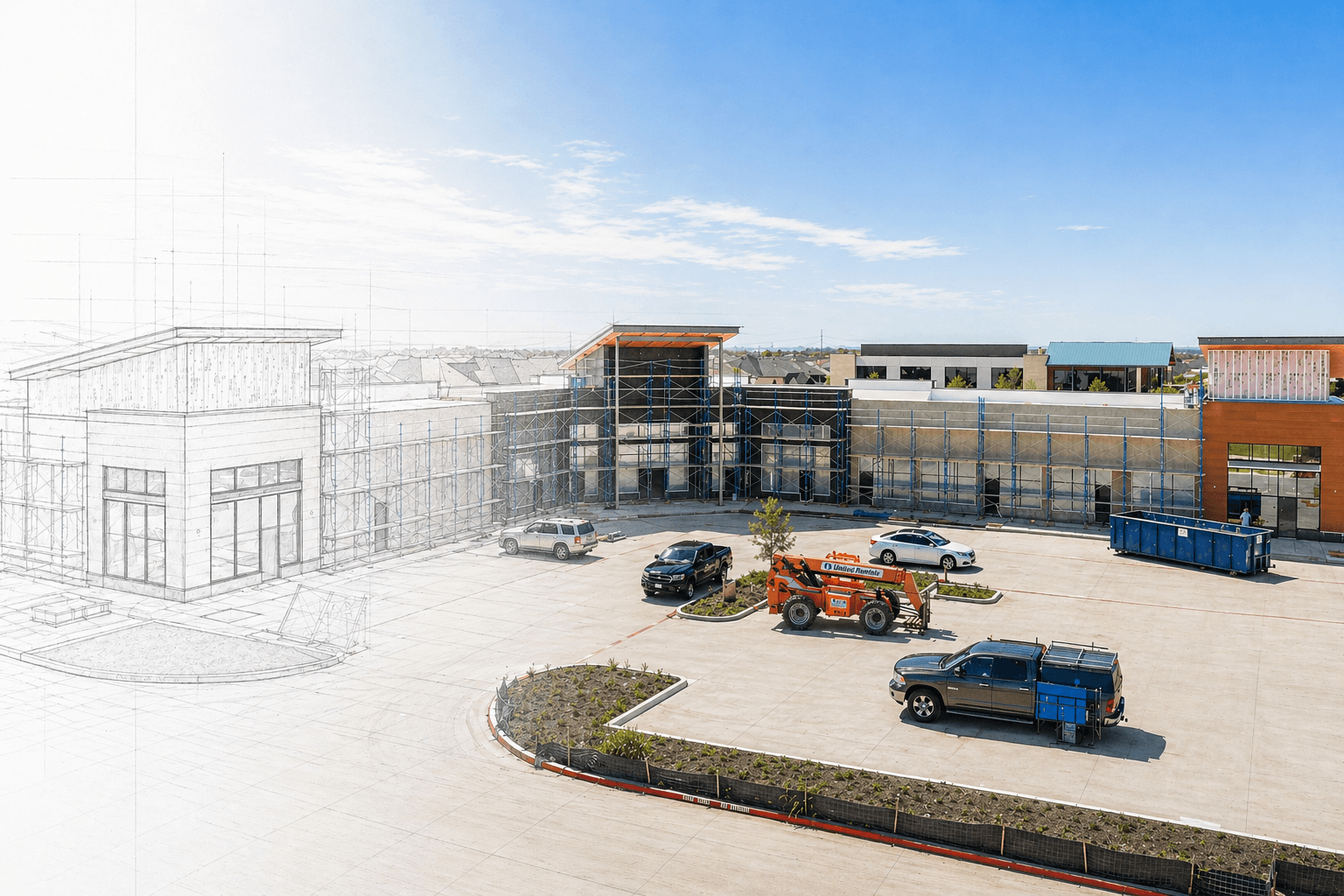

10 Common Causes of Commercial Construction Delays in Texas
Discover the common causes of commercial construction delays in Texas, from permit issues and labor shortages to weather, material delays, and poor coordination.
Texas never sits still. From Dallas–Fort Worth to Houston, Austin, and San Antonio, new headquarters, warehouses, data centers, and medical campuses keep rising.
Yet for every ribbon-cutting that happens on time, there is a project owner somewhere staring at a calendar that no longer makes sense.
If you are a developer, owner, or investor, you already know a delay is more than an inconvenience.
It means extra financing costs, lost rent, missed opening dates, and strained relationships. The good news is that most delays have recognizable causes.
Once you understand them, you can plan around them, and an experienced Texas commercial general contractor like TX Sparks Construction can help you do exactly that.
Below are ten of the most common reasons commercial projects in Texas fall behind, supported by recent industry data, along with practical ideas to protect your timeline.
1. Skilled Labor Shortages
Let's start with the biggest culprit.
In the workforce survey by the Associated General Contractors of America (AGC) and NCCER, 92% of construction firms reported trouble finding qualified workers, and worker shortages were the reason for delays that respondents listed most often.
Texas feels this pressure more than most states.
According to the Dallas Fed, 53% of Texas construction trades workers were foreign-born in 2024, which means changes in immigration enforcement can ripple through job sites quickly.
AGC also found that nearly one-third of firms nationwide had been affected by enforcement actions.
What helps: secure your key subcontractors early, ask how they plan to staff your job, and consider off-site prefabrication to reduce the number of workers needed in the field.
You can also read: 10 Questions to Ask a Commercial General Contractor in Texas Before Hiring.
2. Tariffs and Material Price Volatility
Next, consider what happens when the cost of materials changes mid-project. Tariffs on steel, aluminum, and electrical components have made pricing harder to predict.
A construction outlook survey reported by the Daily Reporter found that roughly 70% of firms were affected by tariffs in 2025, and about 40% responded by raising bid prices.
Because of this, budgets get reopened, scopes get trimmed through value engineering, and schedules slide while everyone renegotiates.
Design Collaborative's chief cost estimator projects nonresidential building inflation of 4.4% in 2026 once tariff effects are included.
What helps: buy critical materials early, build escalation language into contracts, and keep a realistic contingency.
3. Supply Chain Disruptions and Long Lead Times
Even when the price is right, the material still has to arrive.
Switchgear, transformers, HVAC units, and specialty equipment can take months to deliver, and a single missing component can hold up an entire trade.
Meanwhile, demand is rising from unexpected places.
JLL expects real spending on data center construction to more than double between 2023 and 2026, which means large projects are competing for the same equipment and the same skilled crews.
Fuel costs add another layer, since oil prices climbed above $100 per barrel in early 2026, raising transportation costs for materials.
What helps: order long-lead items during design, not after groundbreaking, and track deliveries as closely as you track construction progress.
You can also read: 11 Things Developers Should Know Before Starting a Commercial Build in DFW.
4. Permitting and Inspection Bottlenecks
Permitting rules and review times vary widely from one Texas city and county to the next.
A project in one jurisdiction may clear review in weeks, while a similar project elsewhere waits months.
In addition, permits are not always "one and done."
Consultants have noted that when tariffs force a change in materials or specifications, permit applications may need to be updated, which restarts part of the review clock. Failed or delayed inspections can then stall the next phase of work.
What helps: hold pre-application meetings with the jurisdiction, consider phased permitting, and bring in a permit expediter for complex projects.
How TX Sparks Construction helps: We offer Design and Permitting and Land Entitlement services in Texas, so approvals and construction planning can be coordinated by one team instead of being passed between several.
You can also read: DFW Commercial Construction Permitting: The Complete Guide.
5. Severe Weather
Texas weather is famously unpredictable.
Gulf Coast hurricanes, North Texas hail, spring thunderstorms, flash flooding, triple-digit summer heat, and the occasional hard freeze (as Winter Storm Uri reminded everyone in 2021) can all halt work.
Contractors working across the state consistently list extreme weather among their top scheduling challenges.
Rain delays concrete pours, wind stops crane operations, and extreme heat limits how long crews can safely work.
What helps: build weather days into the baseline schedule, sequence work so the building is "dried in" as early as possible, and protect stored materials.
You can also read: 5 Steps to Reduce Construction Delays in North Texas Projects.
6. Unexpected Soil and Site Conditions
What lies beneath the surface can derail a schedule before the first wall goes up.
Texas is known for expansive clay soils, such as the Blackland Prairie clays and Houston's shifting "gumbo," and for limestone and karst features in parts of Central Texas.
Contractors in the state cite soil variability as a recurring challenge.
When crews hit poor bearing soils, groundwater, or rock that nobody anticipated, foundation designs change, and so do timelines and budgets.
What helps: invest in a thorough geotechnical investigation before design is finalized. It costs far less than redesigning a foundation mid-construction.
How TX Sparks Construction helps: We offer Land Feasibility services in Texas that evaluate a site's potential before you commit, a natural point to surface site risks early.
7. Design Changes and Incomplete Plans
Sometimes the delay starts on paper. Incomplete drawings, conflicting details, and late owner-requested changes generate requests for information (RFIs), change orders, and rework.
Each one pauses work while someone answers, approves, or reprices.
Similarly, tenant-driven changes can send ripples through mechanical, electrical, and plumbing systems that were already coordinated.
What helps: freeze the design as early as possible, run a detailed pre-construction plan review, and use 3D coordination (BIM) to catch clashes before they reach the field.
How TX Sparks Construction helps: We have an in-house engineering team with end-to-end capability, which keeps design questions and field decisions closer together.
You can also read: General Contractor vs. Construction Manager vs. Design-Build Firm.
8. Utility Coordination and Power Availability
A beautiful building is not much use without power, water, and sewer.
Utility providers have their own schedules, and Texas's rapid growth means demand for electrical service and infrastructure upgrades is high in many markets.
As a result, projects sometimes finish construction only to wait on a utility connection or a transformer before they can open.
What helps: contact utility providers during site selection, confirm capacity and timelines in writing, and treat utility milestones as critical-path items.
How TX Sparks Construction helps: We offer Land Development and MUD & PID services in Texas to address groundwork and development approvals ahead of vertical construction.
9. Financing and Interest Rate Pressure
Money problems are schedule problems.
Industry analysts note that volatile, elevated interest rates have slowed growth in commercial construction, and Texas contractors report that market volatility and rising material costs can lead to delays or even cancellations.
When funding tightens, or draws are late, payments to subcontractors slow down. In turn, subcontractors reduce crews or move them to other jobs, and your project loses momentum.
What helps: confirm funding structure before you break ground, maintain a healthy contingency, and pay on time to keep trades committed.
How TX Sparks Construction helps: We state that it is bondable, subject to project-specific evaluation and financial qualifications, which can add financial security to a project.
You can also read: 7 Ways to Make a Commercial Construction Project Bankable in Texas.
10. Poor Planning, Communication, and Coordination
Finally, many delays come down to people and process. Fast-track schedules, overlapping trades, and unclear communication create conflicts that no one sees until they become costly.
A concrete crew arrives before the forms are ready, or an inspector shows up before the work is complete.
The larger the project, the more handoffs there are, and each handoff is a chance for something to slip.
What helps: choose an experienced general contractor in Texas, run weekly look-ahead meetings, use pull planning so trades agree on sequencing, and keep everyone working from a shared platform.
You can also read: Commercial Construction in Fort Worth: Permits to Project Delivery.
How TX Sparks Construction Helps Keep Texas Projects on Track
TX Sparks Construction is a Texas commercial general contractor that guides projects from early feasibility through construction and final delivery.
The services include ground-up construction, interior build-outs, land development, land feasibility, land entitlement, design and permitting, MUD & PID services, and construction management.
Several parts of its approach speak directly to the delay causes above:
Integrated planning: feasibility, design, permitting, and construction sit under one roof, which means fewer handoffs where schedules can slip.
Centralized communication: TX Sparks Construction says it uses centralized communication and documentation. Clients on its website also praise the Super Construct app for progress updates.
On-time delivery: the company states a 100% on-time completion record.
Local track record: it recently completed Lexington Square, a 41,560-square-foot ground-up commercial development in Frisco.
Client feedback: TX Sparks Construction shows a 5.0 Google rating across 16 reviews as of October 2026.
You can also read: What Does a Commercial General Contractor Do in Texas?
How to Keep Your Texas Project on Schedule
As you can see, most delays are not caused by a single dramatic event. They build up through small gaps in labor, materials, approvals, and communication.
However, the pattern is also encouraging, because nearly every cause on this list can be reduced with early planning.
Here is the short version:
Plan early: complete design, geotechnical work, and utility checks before construction starts.
Order smart: buy long-lead and tariff-sensitive materials as soon as possible.
Staff strategically: lock in subcontractors and consider prefabrication.
Build in buffers: include time for weather, permitting, and inspections.
Communicate constantly: hold regular meetings and resolve issues quickly.
Texas will keep growing, and demand for commercial space is not slowing down.
The owners who finish on time are rarely the luckiest. They are the ones who anticipate problems before they appear.
If you are planning a project, talk with an experienced Texas contractor such as TX Sparks Construction early, and ask them directly how they will handle each of the risks above.
Frequently Asked Questions
1. What is the most common cause of commercial construction delays in Texas?
Skilled labor shortages are the most common cause. In the 2025 AGC and NCCER survey, 92% of firms had trouble hiring qualified workers, and worker shortages were the delay reason respondents listed most often. In Texas, 53% of construction trades workers were foreign-born in 2024, so labor policy changes can hit schedules quickly.
2. How long does commercial permitting take in Texas?
There is no single timeline because review times vary by city and county. Pre-application meetings, complete submittals, and phased permitting can shorten the process. A contractor that handles design and permitting, like TX Sparks Construction, can help keep approvals aligned with the construction schedule.
3. How do tariffs affect commercial construction schedules in Texas?
Tariffs raise material costs and can trigger re-bidding, redesign, and procurement delays. About 70% of firms reported being affected by tariffs in 2025, and roughly 40% raised bid prices in response. Ordering critical materials early and adding escalation clauses to contracts helps limit the impact.
4. Can weather delay commercial construction in Texas?
Yes. Hurricanes, hail, flash floods, extreme heat, and winter freezes can all pause work. Build weather days into the schedule, dry in the building early, and protect stored materials to reduce the risk.
5. How can I prevent delays on my commercial construction project?
Plan early and communicate often. Complete design and site investigations before groundbreaking, confirm utility timelines, order long-lead materials during design, secure funding, and hold regular schedule reviews with your contractor.
6. What should I look for in a commercial general contractor in Texas?
Look for relevant Texas project experience, in-house design or engineering capability, clear communication and documentation, bondability, and verifiable client references. Ask how the contractor handles permitting, labor, and material risks, since those drive most delays.
Ready to Build on Schedule? Talk to TX Sparks Construction
Don't let avoidable delays cost you time and money. Whether you are planning a ground-up development, an interior build-out, or a land project, the TX Sparks Construction team can help you plan, build, and deliver with transparency from the start.
Contact the team, call +1 (469) 598-2558, or email info@txsparks.com
Disclaimer: This article is provided for general educational and informational purposes only and does not constitute professional, legal, financial, or engineering advice. While TX Sparks Construction makes every effort to keep this content accurate and current, we make no warranties as to its completeness, accuracy, or reliability. Construction codes, regulations, and requirements vary by location and project and are subject to change. Any action you take based on this information is strictly at your own risk. For guidance specific to your project, please consult a qualified professional or contact our team directly.