
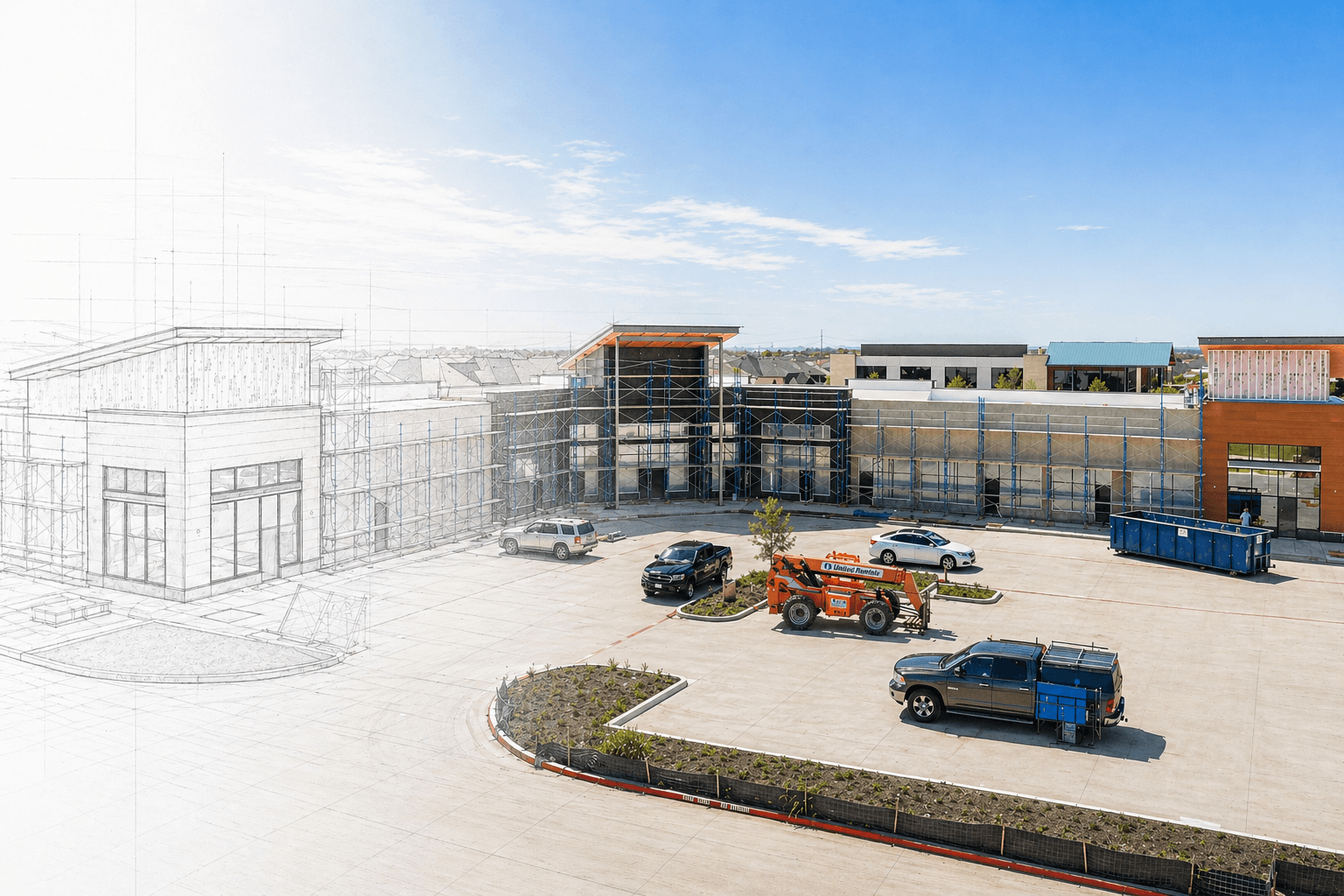

6 Common Causes of Commercial Construction Delays in Texas
The common causes of commercial construction delays in Texas, including permitting issues, labor shortages, weather, design changes, and poor coordination.
Texas is one of the busiest commercial construction markets in the country. Data centers, warehouses, hospitals, and mixed-use developments are rising from Houston to El Paso.
Yet even in a market this strong, a surprising number of projects open late and over budget.
If you are a developer, owner, or contractor, that delay is more than an inconvenience.
Every extra week means more interest on your loan, higher general conditions costs, and a later start on revenue.
For tenants and investors, it can also mean missed opening dates and strained relationships.
The good news is that most delays have recognizable causes. Once you know where projects typically stall in Texas, you can plan around the risks instead of reacting to them.
Below, we walk through the most common causes of commercial construction delays in Texas, the data behind them, and how an experienced partner like TX Sparks Construction helps keep your schedule on track.
1. Skilled Labor Shortages and Workforce Disruptions
If one problem sits at the top of the list, it is labor.
The Associated General Contractors of America (AGC) has described workforce shortages as the leading cause of construction project delays nationwide, and Texas is no exception.
The numbers back this up. In AGC's Texas survey, 61% of contractors expect it to be hard or harder to hire hourly craft workers in 2026.
Meanwhile, 59% named rising direct labor costs as a major concern, and 57% pointed to an insufficient supply of workers or subcontractors.
Nationally, a separate AGC and NCCER survey found that 92% of firms struggle to find qualified workers.
Immigration enforcement has added another layer of uncertainty.
In a Dallas Fed interview with AGC chief economist Ken Simonson, 41% of Texas survey respondents said enforcement actions affected them.
That matters because foreign-born workers make up 53% of Texas construction trades workers, compared with 35% nationally, based on 2024 Census data.
Because commercial projects depend on tightly sequenced trades, even a small staffing gap can ripple through the entire schedule.
As a result, a missing crew rarely delays only one task. When drywall waits on framing, and finishes wait on drywall, a two-week labor gap can easily become a two-month slip.
That is why TX Sparks Construction builds scheduling, milestone tracking, and on-site coordination into its construction management service.
You can also read: 11 Things Developers Should Know Before Starting a Commercial Build in DFW.
2. Rising Material Costs, Tariffs, and Supply Chain Pressure
Material prices are the next major factor. Cushman & Wakefield projected construction material prices would rise 5.4% to 6.8% in 2026, largely due to tariffs. The Dallas Fed interview with Ken Simonson adds sharper detail.
From December to December, producer prices rose 31% for aluminum mill shapes, 17% for steel mill products, and 12% for copper and brass mill shapes, with tariffs of 50% applied to steel, aluminum, and copper-containing products.
Those are exactly the materials that go into structural frames, electrical systems, and HVAC equipment.
Notably, the supply chain itself has calmed down. Only 38% of AGC's Texas respondents reported significant supply chain problems in 2025.
However, input costs remain well above pre-2020 levels, and that creates a different kind of delay.
When bids come in over budget, owners often pause to redesign, re-bid, or secure additional financing.
In short, a material problem is often a decision problem. The longer an owner waits to approve a substitution or a price increase, the longer the schedule sits idle.
Early value engineering and procurement planning, both part of TX Sparks Construction's construction management service in Texas, help owners make those calls sooner.
You can also read: 10 Questions to Ask a Commercial General Contractor in Texas Before Hiring.
3. Permitting and Approval Bottlenecks
Texas has made real progress here, but permits still trip up projects.
On the positive side, PermitPlace's 2026 analysis found that initial plan review across 81 Texas cities averaged 17.4 days, compared with a national average of 22.9 days.
Yet initial review is only one step. Zoning, utility, and engineering sign-offs can stretch the full timeline far beyond that figure.
Dallas shows both the problem and the progress.
According to a city memo reported by The Dallas Morning News in late 2024, the median time to issue a new commercial permit dropped from 300 days to 122 days.
That is a big improvement, but four months is still a long wait for a project carrying construction financing.
In Austin, one local permit expediting firm estimates that zoning and permitting for a commercial project can take 12 to 14 months.
The state has stepped in as well. House Bill 14 allows third-party reviewers and inspectors to assist when a municipality fails to complete reviews or inspections on time. Still, incomplete drawings, intake errors, and slow responses to review comments can erase that benefit.
Submitting a complete package the first time remains the most reliable shortcut, and it is the goal of TX Sparks Construction's Design and Permitting service, which coordinates architects, engineers, and municipal authorities through zoning, entitlements, utility approvals, and permitting.
You can also read: DFW Commercial Construction Permitting: The Complete Guide.
4. Extreme Texas Weather
Few states face as many weather extremes as Texas.
Hurricanes and flooding threaten the Gulf Coast, hail and tornadoes sweep through North Texas, and summer heat can limit working hours.
Even ordinary rain can bring crews to a standstill. TxDOT has noted that rain is the weather condition that most often affects construction projects.
The February 2021 winter storm showed how far the effects can reach.
The president of AGC of Texas called it historic, with weather advisories issued for all 254 counties, and work halted on projects from Dallas to Austin.
Although most contracts include weather days, extreme events often exceed them.
Legal commentators note that unforeseen severe weather is usually treated as an excusable delay, which can earn a contractor extra time but not necessarily extra money.
That distinction matters, so review your force majeure and delay clauses before storm season, not after.
You can also read: Infrastructure Costs in Texas Developments: What Investors Ignore.
5. Financing Pressure and Mid-Project Changes
Money problems quietly delay more projects than most owners admit.
In AGC's Texas survey, 48% of respondents reported that at least one project had been canceled, postponed, or scaled back in the previous six months.
The survey commentary tied this partly to higher interest costs, which leave less of each loan available for actual construction.
When financing tightens, owners often respond with redesigns or value engineering. Each revision sends drawings back to the architect, the engineer, and frequently the permitting office.
Consequently, a two-week budget fix can reset several steps at once.
You can also read: Commercial Construction Insurance and Liability in Texas: What You Should Know.
6. Planning and Communication Gaps
Finally, many delays begin before the first shovel hits the ground. Incomplete drawings, unclear scopes, and unrealistic schedules all leave small cracks that widen under pressure.
Poor communication between owners, designers, and subcontractors makes them worse.
Projects that struggle often lack three things: a realistic schedule that accounts for Texas permitting and weather, a clear decision-making process on the owner's side, and early contractor involvement during design.
Fortunately, these gaps are the easiest to close because they depend on process rather than outside forces.
TX Sparks Construction, for example, positions its construction team as a single point of accountability among architects, engineers, contractors, consultants, and municipalities.
Its Land Feasibility service also evaluates regulatory constraints, infrastructure, and financial viability before design drawings begin, when changes are cheapest.
You can also read: Commercial Construction in Fort Worth: Permits to Project Delivery.
How to Reduce Delays on Your Next Texas Project
You cannot control the weather or the tariff schedule.
However, you can control how well your project absorbs those shocks. Start with these steps:
Bring your contractor in early. Preconstruction input helps catch pricing, sequencing, and permitting issues while changes are still cheap.
Submit complete permit packages. Pre-application meetings and careful quality checks reduce comment cycles. If your city misses its deadlines, ask about third-party review under House Bill 14.
Lock in materials and trade partners early. Ordering long-lead items sooner and using price-escalation clauses protects you from tariff swings.
Build real buffers into the schedule. Allow float for Gulf Coast storm season, North Texas hail, and winter freezes.
Strengthen your contracts. Clear force majeure, excusable delay, and escalation clauses reduce disputes.
Choose an integrated partner. One team handling feasibility, permitting, and construction, as TX Sparks Construction does, means fewer handoffs where delays creep in.
You can also read: What Does a Commercial General Contractor Do in Texas?
Conclusion
Commercial construction delays in Texas rarely come from one dramatic failure. More often, a labor gap, a price jump, a slow permit, and a rainy week stack up until the schedule gives way.
The encouraging part is that each of these risks can be managed with early planning, honest scheduling, and strong contracts.
If you are preparing a project, start by testing your schedule against these six causes.
Then ask your team which ones pose the greatest risk for your site and timeline. A few smart decisions now can save you months later.
Frequently Asked Questions (FAQs)
1. What is the most common cause of commercial construction delays in Texas?
Skilled labor shortages are the most common cause. AGC describes workforce shortages as the leading cause of construction project delays nationwide, and 61% of Texas contractors in its survey expect hiring hourly craft workers to be hard or harder in 2026. Material costs, permitting, weather, and financing changes follow closely.
2. How long does a commercial building permit take in Texas?
It depends on the city and the project. Initial plan review averaged 17.4 days across 81 Texas cities in PermitPlace's 2026 analysis, but the full process takes longer. Dallas reported a median of 122 days to issue a new commercial permit in late 2024, and one Austin firm estimates 12 to 14 months for zoning and permitting.
3. How do tariffs affect commercial construction costs in Texas?
Tariffs raise the price of steel, aluminum, and copper, which can trigger redesigns, re-bids, or financing gaps. Cushman & Wakefield projected material price increases of 5.4% to 6.8% in 2026, and a Dallas Fed interview cited 50% tariffs on steel, aluminum, and copper-containing products.
4. Does Texas weather cause construction delays?
Yes. TxDOT notes that rain is the weather condition that most often affects construction, and severe events such as the February 2021 winter storm halted projects across the state. Add schedule float for storm season and review your contract's force majeure language.
5. What is House Bill 14 and how does it affect permitting?
House Bill 14 lets third-party reviewers and inspectors help when a municipality fails to complete permit reviews or inspections on time. It is meant to reduce permitting backlogs for builders and developers.
6. What is an excusable delay in a construction contract?
An excusable delay is one beyond both parties' control, such as unforeseen severe weather. It typically earns the contractor more time, but not necessarily more money. Delays caused by the other party may be compensable. Your contract language controls the outcome.
7. How can I reduce the risk of delays on a commercial project in Texas?
Involve your Texas general contractor early, submit complete permit packages, order long-lead materials sooner, add weather float, and set firm approval deadlines. Working with a firm that manages feasibility, permitting, and construction together can also reduce handoff gaps.
8. What services does TX Sparks Construction offer?
TX Sparks Construction offers land feasibility, land entitlement, design and permitting, MUD and PID services, land development, ground-up construction, interior build-out, and construction management for commercial projects in Texas.
Ready to Keep Your Next Texas Project on Schedule?
Whether you are planning a ground-up build, an interior build-out, or a land development, TX Sparks Construction can help you plan around these risks from day one. Get a free budget estimate, book a 30-minute consultation, call +1 (469) 598-2558, or email info@txsparks.com to discuss your project.
Disclaimer: This article is provided for general educational and informational purposes only and does not constitute professional, legal, financial, or engineering advice. While TX Sparks Construction makes every effort to keep this content accurate and current, we make no warranties as to its completeness, accuracy, or reliability. Construction codes, regulations, and requirements vary by location and project and are subject to change. Any action you take based on this information is strictly at your own risk. For guidance specific to your project, please consult a qualified professional or contact our team directly.